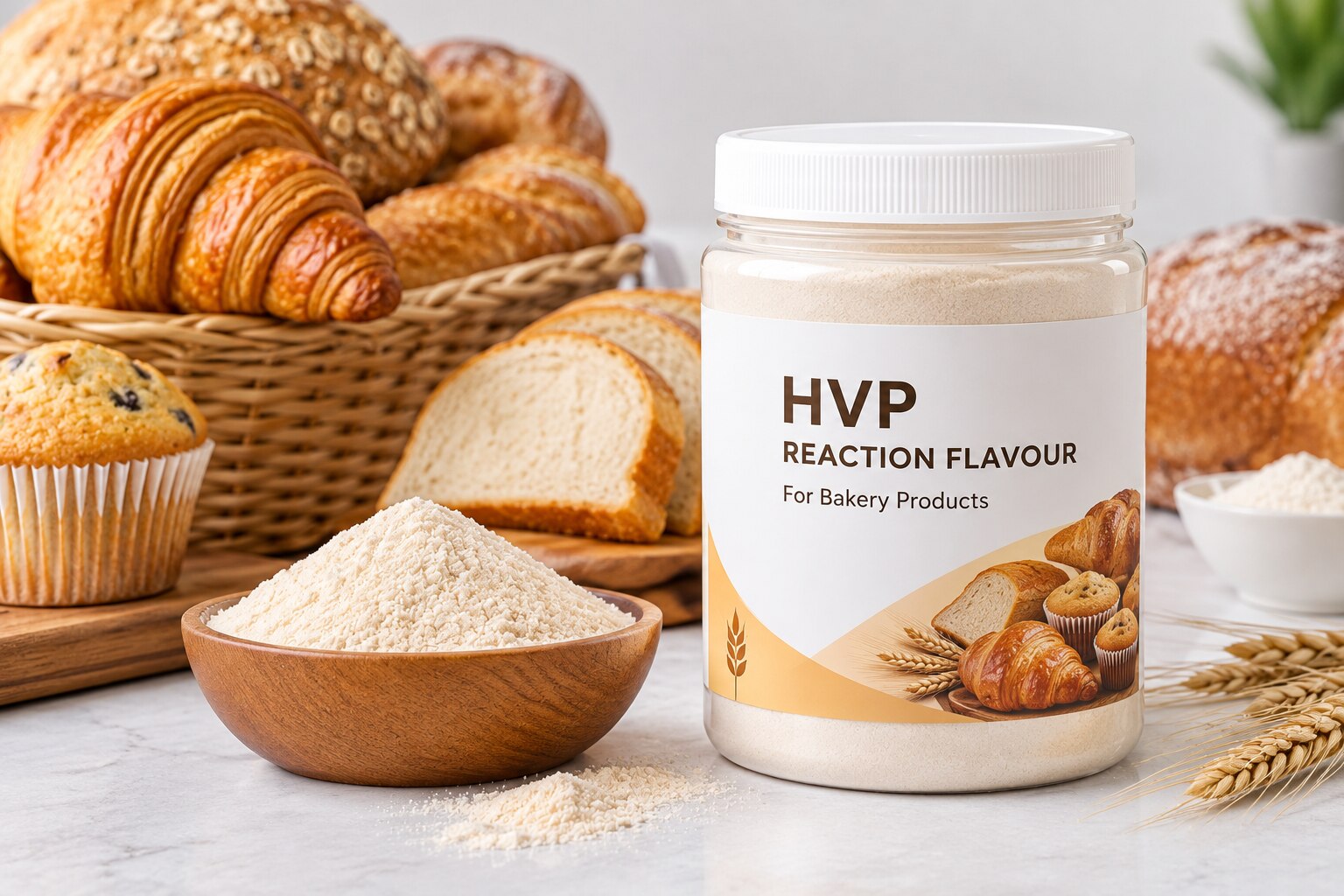
A chicken-style reaction flavour can perform well in savoury baked foods yet clash with butter, sugar, dairy, fruit, chocolate or delicate cereal notes. You will be able to screen the right bakery applications, design a finished-product trial, calculate a defensible starting level and qualify an HVP supplier for Delhi NCR conditions.
Key takeaways
- Test chicken reaction flavour in the finished baked product, not only in a liquid sample.
- Use savoury fillings and snack bases; avoid delicate sweet bakery profiles.
- Record dosage, oven temperature, bake time and application point in every trial.
- Verify batch documents, allergen details, specifications and supplier traceability before approval.
Why a chicken reaction flavour can clash with bakery profiles
A chicken reaction flavour is not judged by the word chicken alone. An hvp reaction flavour for bakery products in delhi must be assessed as a complete sensory profile: HVP supplies soluble peptides, amino acids and umami, while controlled heating of amino compounds with reducing sugars creates roasted, cooked-meat and sulphury character.
The main bakery failure modes are:
- Chicken notes survive the bake and sit awkwardly beside sweet or milky aromas.
- A metallic or bitter aftertaste appears after heating.
- Moisture loss concentrates sulphur until it dominates the finish.
- Savoury intensity overwhelms butter, milk, vanilla, sugar, fruit, chocolate or mild cereal notes.
Two products labelled reaction flavour can behave very differently. The precursor ratio, pH, temperature and reaction time determine roast depth, sulphur impact, bitterness and bake stability; a supplier sample that seems balanced in dilution can become brothy after baking.
HVP can also increase perceived saltiness and push the formula towards broth or bouillon. Recheck salt, yeast extract, MSG, spices and other seasoning ingredients rather than adding the flavour without reformulation. Judge the baked product for aroma, crumb, first taste and aftertaste, not the ingredient name.
If the intended profile is delicate, sweet or dairy-led, a chicken reaction flavour is likely the wrong sensory direction unless the bakery product has an explicit savoury concept.
Which bakery products are suitable, and which are poor fits?
Chicken reaction flavour applications fit best where roasted, umami and cooked-meat notes have an obvious job. Sweetness, dairy, fruit and delicate cereal aromas leave little room for them, so use reaction flavour for bakery products cautiously in these formats.
| Product type | Fit | Practical decision |
|---|---|---|
| Sweet bread, milk buns, butter-rich brioche | Poor starting point | Proceed only with an intentional savoury concept; chicken notes can overpower butter, milk and yeast aroma. |
| Vanilla products, fruit-filled pastries, chocolate bakery, neutral cakes | Poor starting point | Avoid unless the filling or topping is deliberately savoury; sugar, fruit and chocolate expose brothy or sulphury notes. |
| Plain bread and plain buns | Caution | Test at low supplier-recommended levels; the flavour can taste intrusive across the whole crumb. |
| Savoury bread and buns with meat-style fillings, cheese, herbs or spice | Clearer fit | Place the flavour in the filling, fat system or seasoning instead of the entire dough when possible. |
| Crackers, savoury biscuits, pizza bases and savoury pastries | Strong candidates | Toasted, salty and spiced profiles can support roasted chicken character. |
| Filled breads and baked snack-style products | Strong candidates | A filling, topping or seasoning dust isolates impact better than dispersing flavour through all the dough. |
Fat can carry or mask the flavour, while low water activity concentrates it. Sugar may make savouriness taste brothy; yeast fermentation can add competing acidity and cereal notes. Balance herbs, pepper and other spices carefully: too little leaves chicken intrusive, while too much hides roasted coherence.
How baking conditions change the flavour you approve
A balanced bench dilution is not enough to approve a reaction flavour for bakery use; the baked matrix can change it completely. Oven temperature and bake duration may intensify roasted, bitter or sulphury notes while driving off volatile top notes.
Dough pH matters too: alkaline ingredients and reducing sugars can shift the reaction toward a darker, harsher profile.
Moisture loss raises flavour concentration as water activity falls. Fat can mask sharpness, carry flavour through the crumb, or expose stale-fat and oxidation notes during storage. A flavour that seems mild in dough can therefore become brothy, lingering or metallic in the finished product.
Run the same formula through these checks:
- Compare the raw mix or shaped dough for immediate chicken, sulphur, salt and savoury impact.
- Compare the cooled baked product at the specified oven temperature and bake duration, judging aroma, aftertaste, crumb and bite.
- Compare the packed product after a defined interval, such as seven or fourteen days, checking oxidation, stale-fat notes, lost top notes and lingering savouriness.
- Include a control with no flavour.
- Include a version with adjusted salt or savoury ingredients so you can see whether the flavour is amplifying MSG, yeast extract, spices or salt perception.
- Record dough pH, bake temperature, bake time and product water activity.
Approve the flavour only when the finished product matches its intended consumer profile. The supplier sample is evidence for screening, not proof of bakery compatibility.
A controlled bakery trial: placement, dispersion and dosage
Choose the delivery point before weighing: dough for an integrated savoury profile, a fat-based filling for a concentrated centre, a glaze for surface impact, a topping or seasoning dust for post-bake aroma, or a post-bake spray when heat stability is weak.
| Delivery point | Sensory result | Best trial use |
|---|---|---|
| Dough | Even, integrated savoury character | Savoury bread, buns and pizza bases |
| Fat-based filling | Concentrated centre with fat-carried aroma | Filled breads and savoury pastries |
| Glaze | Surface-led flavour and aroma | Products needing a visible top note |
| Topping or seasoning dust | Post-bake aroma with no oven exposure | Crackers and savoury snacks |
| Post-bake spray | Protects heat-sensitive flavour | Weakly heat-stable reaction flavour for bakery products |
Run the trial against the supplier’s named application and recommended range, not a universal dosage. Weigh total dough or total seasoning, then calculate each quantity as:
trial quantity = total weight × supplier-recommended percentage
Verify the permitted use level before production. Include at least four samples:
- Control with no flavour
- Low supplier-recommended level
- Middle supplier-recommended level
- High supplier-recommended level
Pre-blend powder with part of the flour, starch, salt or another compatible dry carrier to prevent hot spots. Disperse it into the specified liquid or fat when the specification permits.
Record dough pH, dough weight, bake temperature, bake time, water activity and storage day. Reject any level that produces bitterness, metallic notes, excessive salt perception or a chicken note that overwhelms the intended bakery profile.
What to verify before approving an HVP flavour supplier in Delhi
Approve an HVP flavour ingredient supplier only after its paperwork, delivery controls and baked-product results agree. A buyer comparing an HVP reaction flavour chicken supplier in Delhi should qualify the material for a Delhi NCR commercial trial, not rely on a bench sample.
- Request the specification, certificate of analysis, batch number, shelf life, storage temperature, pack size, minimum order quantity, lead time, delivery conditions and sample-to-commercial batch traceability.
- Verify source protein, hydrolysis method, HVP solids, added sodium chloride, MSG, yeast extract, carriers, moisture, colour, flavour classification and recommended bake application.
- Obtain soy or wheat allergen information, vegetarian or non-vegetarian status, chicken tissue or animal-origin declaration, halal documents where needed, and FSSAI ingredient and labelling guidance.
- If acid hydrolysis is used, request a recent 3-MCPD result and the manufacturing route.
Check these commercial controls before releasing a purchase order:
| Item | Ask for or inspect | Why it matters |
|---|---|---|
| Delhi transport | Temperature limits, heat-abuse data and delivery conditions | Heat can darken or destabilise the flavour |
| Opened pack | Post-opening shelf life and stability data | Repeated opening can cause oxidation or microbial deterioration |
| Liquid material | Sedimentation, phase separation and viscosity change | Poor dispersion creates uneven flavour in dough or filling |
| Commercial batch | Retained sample and sensory comparison | Confirms the trial matches the supplied batch |
YNP Ingredients Pvt Ltd can be evaluated against this same checklist as a Delhi-based sourcing option. Approve the commercial trial only when documents, delivery conditions and finished-bake aroma, aftertaste and texture results agree.
Related product
 | Seasoning Snack HVP RFC (Reaction Flavour Chicken) HVP RFC (Reaction Flavour Chicken) is a widely used food ingredient in the seasoning and processed food industry, known for delivering rich... View product → |
Frequently asked questions
Why can chicken reaction flavour clash with bakery profiles?
Chicken HVP reaction flavour combines umami with roasted, cooked-meat and sulphury notes. Those notes can overpower butter, vanilla, fruit, chocolate and other delicate bakery aromas.
Which bakery products suit chicken reaction flavour?
Savoury biscuits, crackers, stuffed breads, meat-filled pastries, seasoning systems and savoury snack bases are stronger fits. Sweet cakes, plain breads, cookies and delicate laminated pastries are poor fits unless the flavour is fully masked by the recipe.
How do baking conditions change the flavour you approve?
Oven temperature, bake time, moisture, fat and the point of addition change aroma release and perceived intensity. Approve the flavour only after testing it in the finished product under production conditions.
How should you run a controlled bakery trial?
Prepare a control and several dosage levels, disperse the flavour consistently, record whether it goes into dough, fat, filling or seasoning, and compare samples after cooling. Keep the batch size, bake profile and evaluation method constant.
What should you verify before approving an HVP flavour supplier in Delhi?
Request the product specification, batch or lot number, certificate of analysis, allergen declaration, ingredient and carrier details, recommended dosage, storage conditions, shelf life, traceability records and applicable food-safety documentation.
Keywords