A manufacturer needs more than a white powder and a supplier invoice to put creatine monohydrate into a finished product. By the end, you will be able to trace the ingredient from supplier approval and incoming inspection through formulation, blending, filling, release, and storage while identifying the controls that protect quality and compliance.
Key takeaways
- Request identity, specification, traceability, and Indian compliance documents before approval.
- Choose food-grade material and a powder format suited to your finished product.
- Calculate the batch addition rate from creatine content, not scoop size.
- Control blending, filling, release testing, and storage conditions at the plant.
Approve the raw material before it reaches the Delhi plant
Approve only after identity, specification, traceability, Indian compliance, and the logistics route are documented. Do not release a shipment because the powder is white; appearance cannot prove authenticity or purity.
For creatine monohydrate for food manufacturers in delhi, record which transaction you are approving:
- Import it directly: confirm the importer of record, country of origin, commercial invoice, packing list, bill of lading, food-import clearance, customs documents, and responsibility for responding to Indian food-import queries.
- Buy cleared Indian stock: verify the distributor’s import records, clearance evidence, lot transfer history, storage conditions, and remaining shelf life. This is the usual basis for comparing creatine monohydrate bulk in delhi.
- Buy packed or repacked material: obtain the original manufacturer’s lot number, repacking date, repacker licence details, new label, weighing record, and chain-of-custody documents. Repacking must not erase the original lot identity.
Before approval, match the certificate of analysis to the delivered lot. Require identity by infrared spectroscopy, assay by a validated HPLC method, loss on drying or water, residue on ignition, heavy metals or elemental impurities, microbiological limits, and residual solvents where relevant. Set acceptance limits before the first purchase.
Inspect sealed, moisture-resistant inner packaging, intact outer cartons, lot labels, manufacturing and retest or expiry dates, and a lot-level retain sample. Ask how the supplier controls reopening, repacking, humid air, and FIFO or FEFO storage. Reject caked, damaged, unlabelled, or untraceable material.
Choose the grade and product format before formulation
A suitable creatine monohydrate formulation ingredient must match the finished format, not just pass an assay. Specify particle-size distribution, bulk density, flow behaviour, moisture, and agglomeration alongside chemical purity because these properties affect capsule filling, tablet weight, sachet accuracy, hopper discharge, and dust during dispensing.
| Format | Main suitability question | Common failure |
|---|---|---|
| Powder scoop or sachet | Does the grade flow and disperse consistently? | Dust, segregation, or poor fill weights |
| Capsule or tablet | Does its density and flow fit the equipment? | Weight variation, sticking, or excessive compression force |
| Cold beverage | Can the target serving dissolve at the intended volume and temperature? | Crystals, sediment, or a gritty mouthfeel |
| Bar or fortified food | Does it tolerate the recipe’s moisture, heat, flavour acids, and storage? | Texture change or stability loss |
At about 20°C, creatine monohydrate has limited water solubility, commonly reported near 14 g/L; warming increases solubility. A high-strength clear drink therefore needs a solubility trial, while a suspension, powder, capsule, or tablet may be more practical.
Micronized material can improve dispersion and reduce visible grittiness, but it does not remove the dose, taste, moisture, or cost constraints.
Before approval, match the proposed creatine monohydrate for nutrition products to the intended Indian category and label. Check the Food Safety and Standards Act, 2006, FSSAI licensing, food-import clearance, and the applicable Health Supplements and Nutraceuticals Regulations, 2016; a foreign food-grade certificate alone does not establish Indian compliance.
Do not copy a 3–5 g daily convention or loading protocol onto the label without confirming serving-size, claim, and category permissions.
Calculate the addition rate and build a controlled dry blend
Calculate the creatine requirement from the finished batch size and target inclusion: 100 kg at 5% requires 5 kg of creatine monohydrate. If the approved assay is 99.5% and the formula requires 5 kg active material, weigh 5.025 kg, unless the label specification is defined by ingredient mass rather than assay-corrected content.
- Lock the formula version, batch size, target inclusion, assay correction, and permitted weighing tolerance before production. Use a calibrated balance, record the operator, scale ID, lot number, actual weight, and reconciliation.
- Inspect the powder for caking, then pass creatine and the main carrier through separately validated sieves. Do not force lumps through the mesh; investigate them.
- Pre-blend the creatine with a small, measured portion of the carrier using geometric dilution. Add progressively larger carrier portions until the premix has a similar particle distribution to the main blend.
- Load the remaining carrier first, add the creatine premix, and add flavours, colours, minerals, or flow aids in the validated order. Adding a concentrated creatine charge directly to the full batch creates pockets that mixing may not remove.
- Mix for the validated time and speed, not simply longer. Excessive mixing can increase segregation after discharge, especially when particle size, density, or flow differs.
- Check uniformity using samples from the mixer’s top, middle, bottom, and discharge beginning, middle, and end. Test creatine with a validated quantitative method, define acceptance limits before manufacture, and hold the batch if results show a location or time trend.
Minimise transfer drops and vibration after mixing, then fill promptly in the planned sequence. Segregation can begin again in the hopper.
Control filling, finished-product release, and warehouse storage
Filling changes with the format because creatine’s flow, density, moisture exposure, and dispersion behaviour do not stay constant after blending.
| Format | Control during filling | Failure to prevent |
|---|---|---|
| Sachets | Check auger or volumetric-fill accuracy and seal integrity | Underweight packs, leaking seals, or caked powder |
| Capsules | Match powder flow and bulk density to capsule-machine settings; verify capsule weight | Weight variation or poor machine discharge |
| Tablets | Control granule moisture, compression force, lubricant level, and tablet hardness | Capping, sticking, friability, or delayed disintegration |
| Protein blends, bars, and fortified foods | Recheck blend uniformity after transfer and control moisture during forming or packing | Creatine-rich pockets, gritty texture, or segregation |
| Liquid products | Confirm dissolution, pH, hold time, agitation, and sedimentation before filling | Crystals, settling, or a gritty mouthfeel |
Do not copy a 3–5 g daily convention onto an Indian label without checking the product category, serving-size rule, permitted claims, and finished-product labelling requirements.
Release the batch against approved specifications: net weight, creatine assay or marker test, blend or dosage-unit uniformity, moisture where relevant, microbiological results, appearance, seal or closure integrity, and format-specific pH, viscosity, disintegration, or sedimentation results.
Keep finished goods quarantined until quality approval. Store released packs lot-segregated in a cool, dry, clean warehouse, away from direct sunlight and humid air. Use FIFO or FEFO, retain samples by lot, and record every opening, repacking operation, transfer, and dispatch.
Compare Delhi sourcing routes by documents, responsibility, and application support
Do not compare quotes until you identify who imported the creatine monohydrate, who owns the batch record, and who answers an Indian food-import query. A lower price can exclude customs clearance, testing, inland freight, repacking, or moisture-controlled storage.
| Route | Documents to demand | Responsible party | Application support |
|---|---|---|---|
| Direct import | Commercial invoice, packing list, bill of entry, country of origin, supplier CoA, lot traceability, identity and HPLC assay results | You or your appointed importer handles customs, FSSAI queries, clearance, and non-conformity | You arrange trials, method review, and stability work |
| Cleared bulk stock | Indian sale invoice, original importer details, bill of entry, original CoA, current lot CoA, storage records, retain-sample confirmation | The Indian distributor owns local delivery and explains import records; you approve the incoming lot | Supplier supports grade selection and sampling; you validate the finished format |
| Repacked material | Original lot link, repacking record, new pack label, net-weight checks, repacker hygiene record, revised CoA linkage | The repacker owns pack integrity and traceability from original to new lot | Supplier must explain particle-size handling, dust control, and compatibility with your filling process |
Approve only when identity by infrared spectroscopy, quantitative HPLC, water or loss on drying, microbiological limits, elemental impurities, and lot numbers match your written specification. Check sealed moisture-resistant packaging, retain samples, and documented FIFO or FEFO storage.
A creatine monohydrate food ingredient supplier such as YNP Ingredients Pvt Ltd becomes easier to assess when it can separate original manufacturer records from distributor or repacker records. Run an application trial before commercial approval: compare flow, dust, fill-weight variation, blending uniformity, and finished-product stability.
Related product
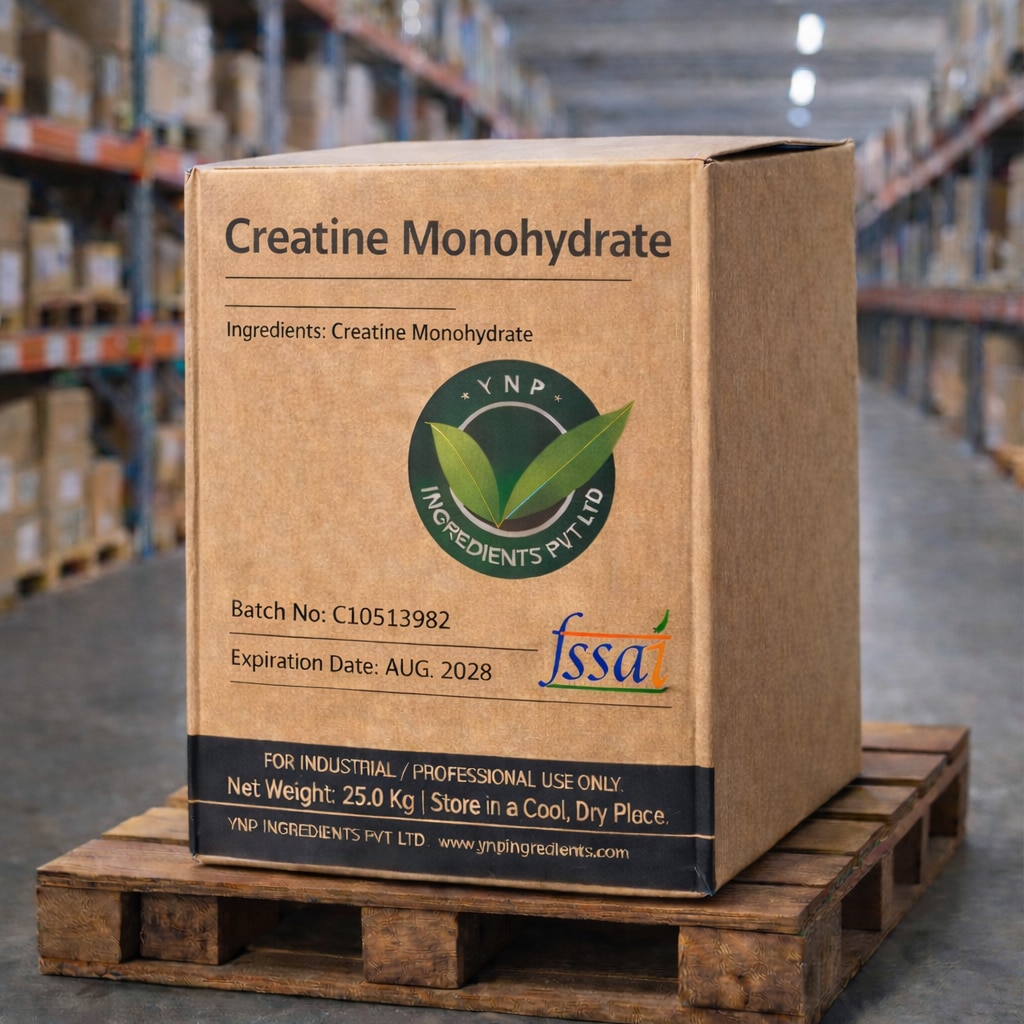 | Amino Acid Creatine monohydrate is a widely used compound in nutraceutical and sports nutrition formulations, known for supporting strength, endurance, and... View product → |
Frequently asked questions
What documents should you approve before creatine monohydrate reaches a Delhi plant?
Review the specification, certificate of analysis, identity information, batch number, traceability records, Indian compliance documents, and the planned logistics route before releasing the shipment.
How do you choose creatine monohydrate grade and format for a food product?
Match the material’s grade, particle characteristics, packaging, and handling properties to the formulation, dry-blending process, filling equipment, and finished-product format.
How should manufacturers calculate creatine monohydrate addition rates?
Calculate the required batch quantity from the target creatine content and the material’s assay, then account for the total batch mass and mixing sequence.
What controls matter after creatine monohydrate enters the plant?
Use a controlled dry blend, verify filling weights, complete finished-product release checks, and store sealed material in a clean, dry warehouse under documented conditions.
Keywords