A formulation can miss its intended citrulline dose even when the label says “citrulline malate 2:1,” because raw-material weight and L-citrulline content are not the same figure. You will be able to calculate the correct input, assess manufacturing behaviour, qualify each lot, and compare supply options for Delhi production.
Key takeaways
- Use 9 g of theoretical 2:1 material for 6 g L-citrulline before corrections.
- Correct the batch quantity using assay, moisture and the declared citrulline ratio.
- Test blend uniformity, dissolution, taste and acidity before scaling production.
- Approve each lot against its COA, identity, contaminants and packaging records.
How do you calculate the usable citrulline dose across product formats?
A 6 g L-citrulline-equivalent serving requires about 9 g of theoretical 2:1 L-citrulline DL-malate before assay and moisture corrections. “2:1” means a weight-to-weight ratio of L-citrulline to malate, not a molar ratio: the theoretical material contains 66.7% L-citrulline and 33.3% malate.
Therefore, 6 g labelled as citrulline malate does not equal 6 g L-citrulline; at 2:1, it supplies about 4 g L-citrulline before corrections.
Citrulline DL-malate formulation uses include high-load pre-workout powders, ready-to-mix sachets and beverages, where serving volume and dissolution matter; capsules and tablets, where dose size can create too many units or compression problems. These are practical considerations for L-citrulline DL-malate for sports nutrition and L-citrulline DL-malate for formulations in Delhi.
- Record the target L-citrulline equivalent and raw-material mass separately.
- Divide the target equivalent by the declared L-citrulline fraction. For 2:1, 6 ÷ 0.667 = approximately 9 g.
- Adjust the weighed quantity using the batch assay and moisture result.
- Compare the result with serving size, dosage form and finished-product category.
An approximately 6–8 g raw-material range appears in many acute exercise studies, but confirm the chosen level against FSSAI requirements and a compliant claims review. Do not compare an unspecified ratio directly with 2:1 material.
Require the specification sheet to state the ratio, weight/weight basis, assay and moisture basis, and record both dose figures in the formulation brief.
What production controls keep the powder uniform and usable?
Reliability starts with the powder’s bulk density, tapped density, flowability, dust generation and sieve profile. Record moisture sensitivity and hygroscopicity too: absorbed water can cause caking, erratic feeding and poor dissolution.
A high-use-level pre-workout creates large scoop-volume and flow changes as density shifts. A low-dose capsule or tablet blend instead risks active-content variation when particles differ in size or density, even though the total ingredient quantity is small. These controls support citrulline DL-malate formulation uses, including L-citrulline DL-malate for sports nutrition.
1. Sieve compatible materials and reject visible lumps. Preblend each low-dose active with a suitable carrier before adding the bulk powder.
2. Add citrulline DL-malate through geometric dilution steps, doubling the mixture progressively so small active pockets do not remain.
3. Incorporate sweeteners and electrolytes in controlled stages. Minimise transfer drops, repeated discharge and long vibration, which separate dense particles from lighter ones.
4. Sample the finished blend from the top, middle and bottom, plus early and late filling points, before compression or filling. Test blend uniformity against the approved specification.
Check particle-size and density compatibility with other amino acids and actives. Record bulk density, tapped density and sieve results for every approved lot; matching assay does not prove matching processing behaviour.
How should you manage dissolution, taste, acidity and product claims?
A powder can blend uniformly and still fail as a drink or sachet: poor wetting, grit, sediment, crystals, harsh acidity or bitterness appear only after hydration. Treat L-citrulline DL-malate for sports nutrition as a finished-format decision, not just a dry-blend ingredient.
1. Run a small-scale solubility trial at the intended water volume and serving temperature. Record dissolution time, then inspect for grit, sediment and visible crystals. Compare fine and agglomerated grades because particle size changes wetting, while hard agglomerates can float or dissolve slowly.
2. Measure pH after hydration. The malate fraction contributes sourness and changes the acid balance; free L-citrulline can contribute bitterness. Select flavour masking and sweeteners through sensory trials, not by copying another label. These are practical citrulline DL-malate formulation uses, not packaging decisions.
3. Separate formulation positioning from proven consumer outcomes. Nitric-oxide, endurance and performance language does not guarantee an effect, and human exercise evidence remains mixed across doses and citrulline-to-malate ratios. Before printing packaging, review the finished-product category, evidence file and permitted claims.
If acidity or sediment remains uncontrolled after adjustment, reject the drink format and choose another raw material or dosage form. A capsule or dry powder may be a better fit.
Which documents and checks qualify a new Delhi production lot?
A “99% purity” claim does not establish how much L-citrulline your formula receives. It could mean chromatographic area, total solids or a calculated blend ratio, while hiding moisture, malate content, dilution or adulteration.
For l citrulline dl malate bulk in delhi, request a batch-specific certificate of analysis containing:
- Lot number, manufacturer, country of origin, L-citrulline assay, malate assay or calculation basis, confirmed weight-to-weight ratio, moisture or loss-on-drying, particle-size data, microbiological limits, heavy-metal results, allergen and residual-solvent statements, shelf life, retest date, storage conditions and packaging specification.
- The supplier’s test methods and acceptance limits for identity, each assay, moisture, microbiology, heavy metals and adulterant screening. Ask how identity distinguishes L-citrulline DL-malate from another amino acid or acidulant.
Check the specification against the purchase order before accepting the lot.
| Check | Record | Failure risk |
|---|---|---|
| 99% purity | Replace with separate assay and ratio results | Wrong citrulline dose |
| 2:1 claim | Confirm weight basis and analytical method | Incorrect malate fraction |
| “Food grade” | Review named limits and documents | Uncontrolled contaminants |
At receiving, inspect intact seals, readable labels, pallet condition and remaining shelf life. Record supplier lot links through dispensing, retain a sample, and store sealed packs away from heat and moisture.
Release a new lot only after identity testing, assay verification, appearance checks and a small pilot blend. Put FSSAI import status and finished-product category review in the approval record before bulk production.
How do you compare suppliers, pack sizes and alternative raw materials?
Compare an l citrulline dl malate ingredient supplier by landed cost per gram of calculated L-citrulline equivalent, not quoted price per kilogram. Use: (material cost + freight + customs-related charges + testing + warehouse cost) ÷ (kilograms received × declared L-citrulline fraction × assay).
| Buying option | Main trade-off | Best fit |
|---|---|---|
| Imported bulk | Lower unit cost, higher MOQ and stock exposure | Confirmed recurring demand |
| Smaller packs | Higher cost per gram, less obsolete inventory | Pilot batches or uncertain demand |
| L-citrulline | Simpler declaration; no malate acid contribution | Single-ingredient citrulline label |
| DL-malate | Supports a formula designed around citrulline plus malate | Combined-acid profile |
Record MOQ, lead time, shelf life on arrival, batch-to-batch consistency, documentation turnaround, retained-sample policy and supply continuity. For Delhi NCR, ask for delivery terms, warehouse temperature and moisture controls, available lots, and the deviation or out-of-specification process.
L-citrulline DL-malate bulk in Delhi is not automatically cheaper: a large lot with short remaining shelf life or slow documents can delay production. Compare pack sizes against forecast consumption and reorder timing.
L-arginine base and L-arginine HCl are different materials; neither replaces citrulline gram-for-gram without assay, taste, sensory, regulatory and claims review. YNP Ingredients Pvt Ltd can help a manufacturer compare documented lots, pack sizes and continuity rather than selecting on price alone.
Related product
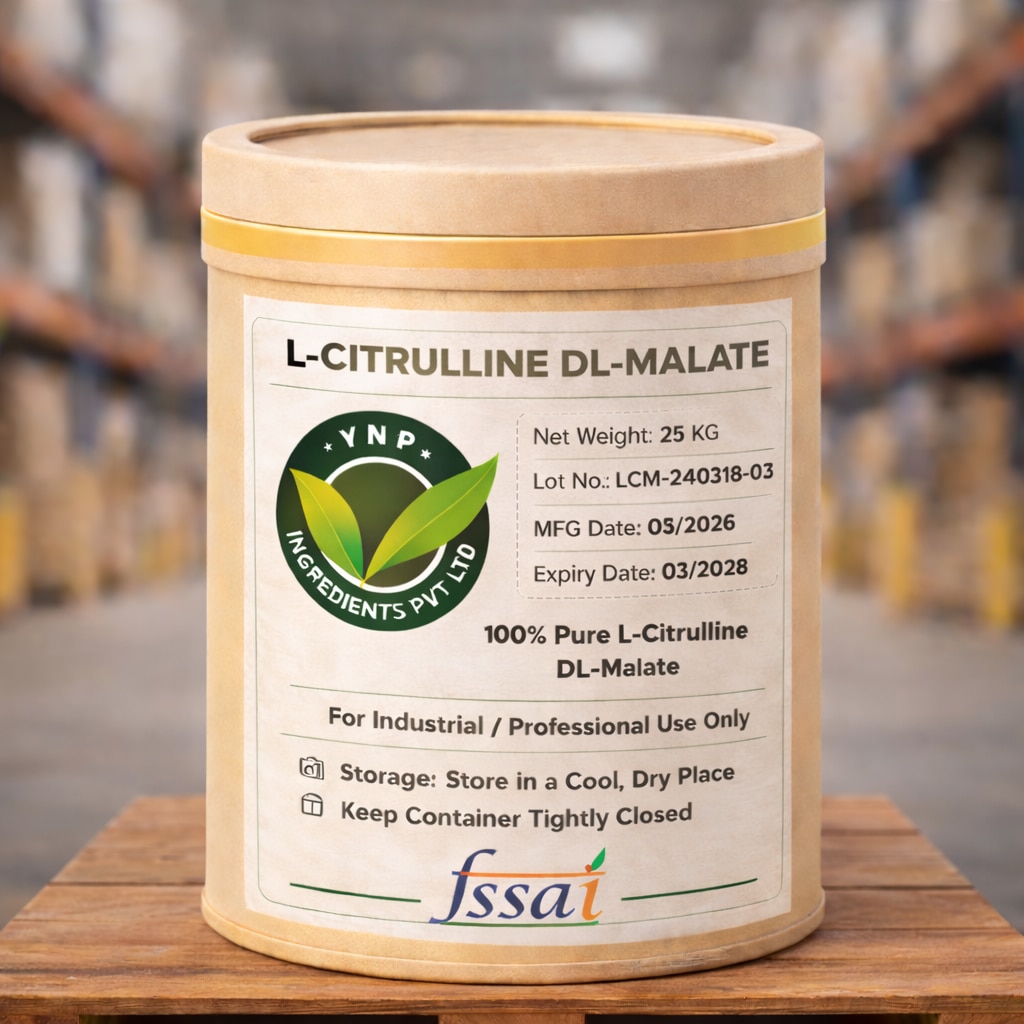 | Amino Acid Derivatives L-Citrulline DL-Malate is a compound of L-citrulline and malic acid, widely used in nutraceutical and sports nutrition food ingredient formulations... View product → |
What approval sequence prevents an expensive production mistake?
A documented gate sequence prevents an incorrect grade from reaching production, especially when buying l citrulline dl malate for formulations in delhi.
- Approve the written specification, including ratio basis, assay, moisture, limits and storage.
- Confirm the citrulline-to-malate ratio and calculate the L-citrulline dose.
- Review the finished-product category, label declaration and claims evidence.
- Test a pilot blend using the intended process and equipment.
- Check dissolution, pH and sensory performance where relevant.
- Confirm compatibility with the container, liner, sachet film or blister.
- Complete finished-product assay and blend-uniformity testing.
- Release the batch with supplier, lot, test and manufacturing records linked.
- Set reorder timing from demand, lead time and remaining shelf life.
Map citrulline dl malate formulation uses to the decision before committing to a large lot.
| Trigger | Risk | Decision |
|---|---|---|
| Need a single-ingredient citrulline declaration | Malate complicates the label | Select L-citrulline |
| Acidic or sediment-prone beverage | Sourness, crystals or sediment survive processing | Run beverage trials or select another material |
| Performance positioning without adequate evidence and claims support | Relabelling or claim rejection | Change the formula or remove the claim |
Choosing the wrong grade creates reformulation, failed uniformity testing, taste correction, relabelling, rejected batches and delayed dispatches.
The reorder record must name the approved supplier, accepted lots, minimum stock, retest dates and change-control obligations. Changes to ratio, manufacturer, process or packaging require documented review before use.
Frequently asked questions
How much 2:1 L-citrulline DL-malate provides 6 g of L-citrulline?
The theoretical calculation is 6 ÷ 0.667, or about 9 g. Adjust that quantity for the supplier’s assay, moisture and actual citrulline-to-malate ratio.
What production controls improve L-citrulline DL-malate powder uniformity?
Control particle-size differences, sieve or de-lump the material, use a validated blending order, limit segregation during transfer and verify blend uniformity before packing.
How should you manage dissolution, taste and acidity?
Run trials at the intended serving volume and temperature, measure pH, check sediment or caking, and assess sourness before choosing flavours, sweeteners or an alternative format.
Which documents should you request for a Delhi production lot?
Request the lot-specific COA, specification sheet, SDS, manufacturing and expiry details, packaging records, allergen statement and test results for identity, assay, moisture, heavy metals and microbiology.
How do you compare suppliers and alternative raw materials?
Compare corrected cost per gram of usable L-citrulline, assay consistency, pack size, lead time, minimum order quantity, documentation, dissolution performance and the trade-offs of L-citrulline versus citrulline malate.
Keywords