Choosing leucine is not a matter of selecting the highest assay or defaulting to a BCAA 2:1:1 blend. The right option depends on the product’s protein base, serving format, sensory profile, dosing logic, documentation, and supply plan; by the end, you can compare those factors before approving a raw material for production.
Key takeaways
- Use L-leucine for single-amino-acid sports nutrition formulas.
- Set the target serving before comparing leucine grades or pack sizes.
- Check identity, purity, microbiology, heavy metals, and allergen documents.
- Pilot-test solubility, taste, blend uniformity, and finished-product stability.
Match the leucine form to the product objective
The answer to which leucine ingredient is best for sports nutrition products in delhi depends on the product objective, not the ingredient name alone. For a single-amino-acid formula, select pharmaceutical-grade or food-grade L-leucine, the naturally occurring form. D-leucine, DL-leucine, and an unspecified leucine blend are not equivalent materials.
Leucine types for supplements compare as follows:
| Option | Best fit | Main trade-off |
|---|---|---|
| L-leucine | Leucine-led powders, capsules, tablets, and custom amino-acid formulas | Gives precise dosing but does not provide the other essential amino acids |
| BCAA 2:1:1 | Products that require leucine, isoleucine, and valine in a fixed ratio | Simplifies BCAA positioning but prevents independent dosing of each amino acid |
| Whey protein isolate or another complete protein | Post-exercise or meal-replacement products needing total essential-amino-acid delivery | Supplies broader nutrition but less isolated leucine control per gram |
Use individual L-leucine when the label requires a controlled leucine dose or a custom amino-acid profile. Choose BCAA 2:1:1 when the product brief specifically calls for all three BCAAs at that ratio.
A complete protein is the stronger base when the formula must support total essential-amino-acid delivery. Adding free L-leucine to whey can raise labelled leucine without proportionally improving the overall amino-acid profile, so compare that addition with simply using a protein that already has a strong complete profile. No option is universally best.
Design the serving before you choose the raw material
Begin with approximately 2–3 g of leucine per high-quality protein serving, treating it as a formulation starting reference—not a universal clinical threshold. Set the dose against total protein, protein quality, serving size, training use, age group, and whether the consumer eats it with a mixed meal.
Leucine ingredient selection for sports nutrition formulations must follow the product’s purpose.
| Option | Best fit | Main formulation issue |
|---|---|---|
| Powdered drink mix | Flexible single-serve dosing | Bitter or savoury taste, limited solubility, sedimentation |
| Sachet or ready-to-mix powder | Portable dose with water | Flavour masking, dispersion, and blend uniformity |
| Capsules or tablets | Precise standalone dosing | High tablet count and compression behaviour |
| Protein powder | Leucine plus complete protein | Compare total essential amino acids, not leucine alone |
| Meal replacement | Balanced nutrition | Standalone leucine is incomplete for the product promise |
The 2:1:1 BCAA ratio is not mandatory. Choose a leucine-led custom BCAA ratio when the brief prioritises leucine while retaining selected isoleucine and valine; use 2:1:1 only when fixed-ratio BCAA positioning matters. During pilot work, check bitterness, aftertaste, dispersion, precipitation, and sedimentation at the intended dose.
Concentration, pH, ionic strength, and temperature affect solubility, so clear beverages can fail after cooling or storage. Adjust the flavour system and mixing method before scale-up.
Standalone leucine is the wrong choice when you need all essential amino acids, a complete protein, a neutral amino-acid profile, or simpler consumer dosing. In those cases, use a complete protein or essential-amino-acid blend instead.
Compare specifications, paperwork, and finished-product compliance
A batch-specific certificate of analysis is the strongest starting evidence: match its lot number to the bag, seal, and invoice. A generic vendor sheet proves only what the supplier intends to sell, not what you received.
| Grade | Suitable interpretation | Evidence to request |
|---|---|---|
| Food-grade L-leucine | Human food or sports-nutrition use | Identity, assay, contaminant, and microbiology limits |
| Pharmaceutical-grade L-leucine | Tighter controlled manufacturing route | Monograph or equivalent quality documentation |
| Feed-grade, D-leucine, DL-leucine, or unspecified leucine | Not automatically equivalent | Technical and regulatory justification before use |
For leucine ingredient selection, check:
- L-leucine identity and minimum assay; particle size; loss on drying or moisture; residue on ignition; heavy metals or elemental impurities; microbiological limits; residual solvents; and bulk density.
- Allergen declaration, country of origin, packaging material and size, lot number, retest or expiry date, and defined storage instructions.
- Product specification sheet, safety data sheet, allergen declaration, non-GMO statement when claimed, and applicable food or nutraceutical compliance documents.
Protect the sealed material from moisture and record the storage temperature range. Confirm shelf life or retest status before opening or repacking; otherwise a compliant incoming lot can become an untraceable, degraded blend.
Finally, review the finished product under the current FSSAI framework: category, permitted ingredients, composition, serving declaration, labelling, claims, and import documents. Ingredient availability alone does not authorise every performance claim.
Qualify an L-leucine supplier in Delhi before placing the order
A Delhi warehouse address does not prove that L-leucine is physically available. The answer to which leucine ingredient is best for sports nutrition products in Delhi is the lot you can receive, approve, document, and replenish without interrupting production.
| Supply route | What to verify | Production risk |
|---|---|---|
| Local stock | Warehouse location, available quantity, remaining shelf life | Lower transit risk, but confirm the actual lot |
| Imported against order | Origin, import documents, arrival date, customs responsibility | Longer lead time and possible delays |
| Domestic stock replenishment | Supplier’s repeat-lot history and replenishment schedule | Risk rises if the next lot is not secured |
Before ordering, ask the L-leucine supplier in Delhi for:
- Minimum order quantity, lead time, delivery plan, packaging sizes, remaining shelf life, and warehouse temperature and humidity records.
- Batch-specific certificate of analysis, import documentation where applicable, lot traceability, specification sheet, allergen declaration, and storage instructions.
- A sample for approval, a written replacement policy for failed specifications or damaged packs, and evidence of repeat-lot consistency and document availability.
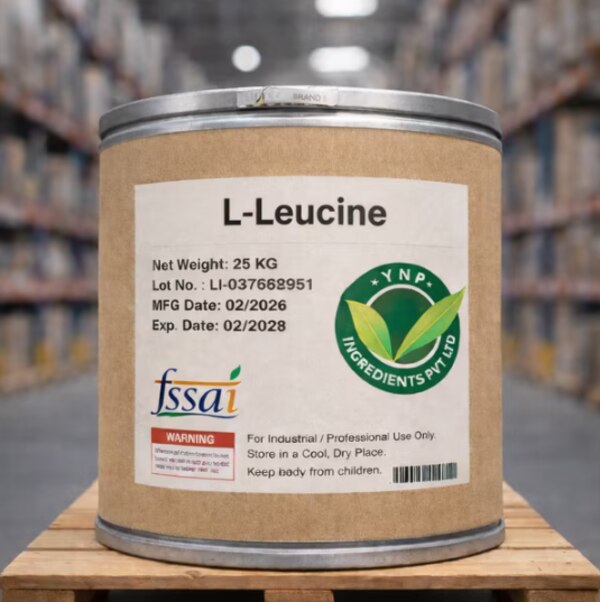
YNP Ingredients Pvt Ltd is one Delhi-based supplier a buyer can evaluate against these checks, not select solely because of location. To prevent a delay when one amino acid is unavailable, approve a backup lot or supplier and hold safety stock based on consumption and lead time.
Do not replace single L-leucine with a BCAA blend without reformulating the label and batch record.
Related products
 | Amino Acid L-Leucine L-leucine is an essential branched-chain amino acid (BCAA) widely used in nutraceutical and sports nutrition formulations for muscle growth,... |
 | Amino Acid L-Isoleucine L-isoleucine is an essential branched-chain amino acid (BCAA) widely used in nutraceutical and sports nutrition formulations for muscle support,... |
Calculate landed cost, production effort, and pilot-batch risk
A 10 g serving containing 5 g of raw material is not automatically cheaper than a 5 g serving containing 3 g. Calculate each option as: inclusion rate in kilograms × delivered price per kilogram, then add allocated freight, duty where applicable, testing, flavour correction, packaging loss, and production labour.
| Option | Cost and control | Manufacturing trade-off |
|---|---|---|
| Separate L-leucine, L-isoleucine and L-valine | Custom ratios and independent dosing; calculate each amino acid separately | More weighing, segregation, dust control and blend-uniformity checks |
| Premixed BCAA | Fewer weighing steps and simpler batch processing | Fixed stated ratio and dependence on one blend specification |
A BCAA label does not equal a leucine ingredient. Confirm the assay and ratio of every amino acid before comparing cost per serving for leucine for sports nutrition formulations.
For leucine ingredient selection, run a pilot blend before scale-up. Test dispersion or dissolution in the final beverage, sensory performance after flavouring, assay confirmation, and stability in the intended packaging. A low raw-material price becomes expensive when bitterness, sedimentation, rework or an assay failure delays release.
- Choose high-purity individual L-leucine for controlled dry-dose products.
- Choose a standard or custom BCAA for a defined BCAA brief.
- Choose complete protein when the product promise requires balanced amino-acid delivery.
Frequently asked questions
Which leucine form fits a single-amino-acid sports nutrition product?
Choose L-leucine, the naturally occurring form. Do not substitute D-leucine, DL-leucine, or an unspecified leucine blend without a documented formulation reason and regulatory review.
What should you decide before choosing a leucine raw material?
Define the product objective, serving size, number of servings, dosage form, flavour system, daily intake, and target market. These decisions determine the required quantity, sensory work, and suitable grade.
Which documents should you request from a leucine supplier?
Request the specification sheet, certificate of analysis for the offered batch, safety data sheet, manufacturing and expiry details, country-of-origin information, allergen statement, microbiology results, heavy-metal results, and applicable food or pharmaceutical-grade documentation.
How do you qualify an L-leucine supplier in Delhi?
Confirm the supplier can provide traceable batches, sealed original packaging, consistent documents, sample quantities, storage information, delivery terms, and technical support for pilot and commercial orders.
What should a leucine pilot batch test?
Test identity, assay, powder flow, dispersion, taste, blend uniformity, fill-weight variation, packaging performance, and finished-product stability before approving the material for routine production.
Related products
 | Amino Acid L-Valine L-valine is an essential branched-chain amino acid (BCAA) widely used in nutraceutical and sports nutrition formulations for muscle support,... |
 | Amino Acid BCAA 2:1:1 BCAA 2:1:1 is a specialized blend of essential branched-chain amino acids (BCAA)—L-leucine, L-isoleucine, and L-valine—in a 2:1:1 ratio, widely used... |
Keywords