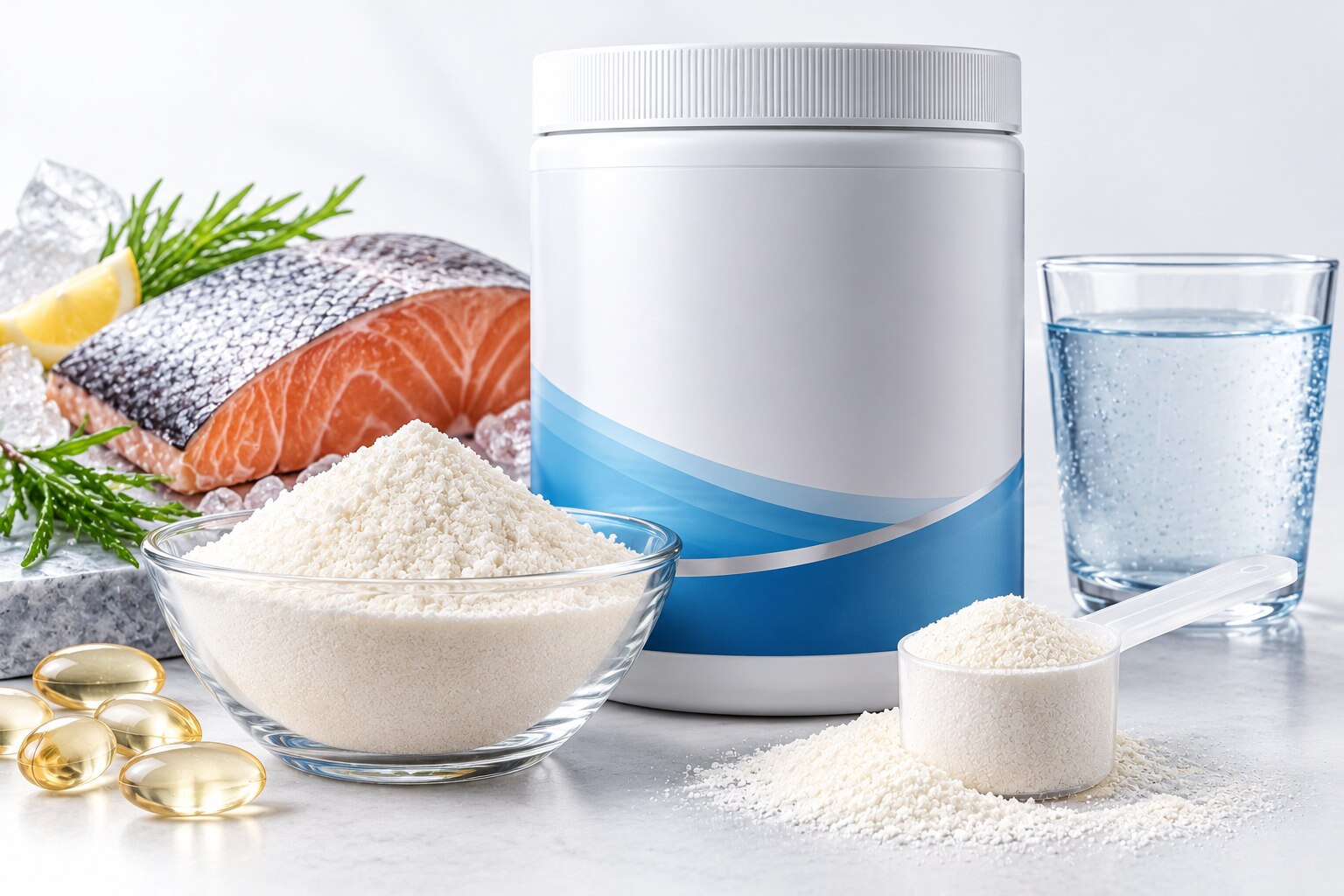
A collagen peptide quotation is not complete until you know the fish species, tissue, hydrolysis profile, assay basis, allergen controls, and behaviour in your finished format. By the end, you will be able to compare grades, calculate a defensible serving dose, test sensory performance, and qualify a Delhi supply partner without relying on the phrase “marine collagen.”
Key takeaways
- Ask for fish species, tissue, collagen type, and hydrolysis details.
- Compare peptide size, assay, and lot-specific certificates before buying bulk.
- Calculate serving dose from assay and the finished product format.
- Test dissolution, stability, odour, taste, and marine sensory performance.
Start with the fish species, tissue, and collagen identity
“Marine collagen” is not a sufficient raw-material identity. Before comparing a fish collagen peptide for supplements, ask the supplier to name the fish species, the tissue used, the collagen type, and the hydrolysis process. Skin, scale, and bone can differ in ash, odour, amino-acid profile, and contaminant controls.
1. Fish species: Request the scientific name, common name, country or region of origin, and marine or freshwater origin.
2. Tissue: Confirm whether the feedstock is skin, scale, bone, or a defined blend. Do not accept “fish-derived” without this detail.
3. Collagen identity: Ask whether the material is predominantly Type I, Type II, or a blend. “Type I collagen” alone does not identify the source or finished peptide.
4. Hydrolysis: Confirm that enzymes produced the peptide, and request the enzyme type or process description. Hydrolysis changes intact collagen into a distribution of smaller peptides.
5. Peptide size: Require the molecular-weight distribution, test method such as SEC-HPLC, reporting basis, and percentage below the stated cutoff. An average alone cannot compare quotations.
6. Identity and controls: For a collagen peptide for nutraceutical products, request hydroxyproline or peptide-profile results plus FTIR or mass spectrometry, along with the fish allergen statement and cross-contact controls.
Also request traceability from finished lot to species and tissue, retained samples, complaint handling, and change notification. These records matter when enzyme, drying, packaging, or feedstock changes alter odour or peptide distribution. Unlike bovine or porcine collagen, fish origin can support marine, dietary, or religious positioning, but it remains a fish-allergen issue.
Compare peptide size, assay, and lot-specific quality evidence
A catalogue specification does not prove that the quoted powder matches your intended grade. Ask a fish collagen peptide bulk supplier for documents tied to the exact production lot, then match every document’s lot number to the bag or drum.
| Evidence | What to demand | What a gap means |
|---|---|---|
| Molecular-weight profile | Lot-specific SEC-HPLC, or an equivalent validated method, stating the reporting basis and percentage below the stated molecular-weight cutoff | A single average molecular weight cannot compare peptide-size distributions |
| Collagen assay | Lot-specific COA showing protein or collagen content, moisture or loss on drying, ash, and pH | The powder may contain significant residual minerals, moisture, or undeclared material |
| Identity and process | Signed specification naming fish species, tissue, collagen type, enzymatic hydrolysis status, and an identity test such as a validated amino-acid or hydroxyproline method | “Marine collagen” alone does not establish the raw material or peptide identity |
| Safety | Lot-specific microbiology and heavy-metal results, with test methods and limits | A generic safety sheet does not clear the offered lot |
| Composition | Full formulation and excipient declaration, including carriers, anti-caking agents, flavouring, sweeteners, or blended proteins | Price-per-kilogram comparisons become misleading |
Reject an old or undated COA. Require a retained sample, traceability from finished lot to fish source and tissue, change-notification terms, and the commercial net weight with packaging configuration. Confirm that the lot number, assay, and molecular-weight report agree; otherwise you cannot show that the tested powder is the powder you intend to buy.
Match the grade to the format and calculate the serving dose
Choose the grade by the product’s usable collagen load, not by the lowest price per kilogram. A fish collagen peptide for supplements must dissolve at the intended concentration and temperature, with acceptable odour, flavour, clarity, pH, and foaming. Confirm peptide distribution by SEC-HPLC, not only an average molecular weight.
| Format | Grade and formulation decision | Dose or risk to check |
|---|---|---|
| Powder | Use a free-flowing, fast-dissolving grade with low marine odour | Calculate active collagen per scoop |
| Sachet | Select a moisture-controlled powder that tolerates repeated handling | Check caking and fill-weight accuracy |
| Drink | Choose a clear or low-turbidity grade at the final pH | Test dissolution, sediment, flavour, and foam |
| Tablet | Use a compressible grade or add a validated excipient system | Large collagen loads create oversized tablets |
| Capsule | Match the grade to capsule capacity and serving count | Calculate whether the required grams fit without too many capsules |
| Gummy | Choose a low-odour grade compatible with heat, acidity, and gel structure | A full collagen dose can make gummies large, soft, or sticky |
| Liquid supplement | Specify concentration, suspension or solution behaviour, and preservative compatibility | Check settling, viscosity, and stability through shelf life |
Calculate the input weight as target active collagen divided by assay fraction. A 5 g serving at 90% collagen requires 5.56 g powder; if the powder contains a carrier, use the declared collagen assay rather than net powder weight. That calculation keeps a collagen peptide for nutraceutical products from being under-dosed.
Test the finished format before approval.
Test dissolution, stability, and marine sensory performance
A fish collagen peptide for supplements passes only when it performs in the finished formula at the intended serving concentration and temperature. Set acceptance limits before testing; a clear drink, for example, needs a different result from a flavoured sachet or compressed tablet.
Run the tests in the actual product matrix, not only in water:
- Dissolve the planned dose in the target liquid and record wetting time, total dissolution time, sediment, clumps, foam, clarity or turbidity, and pH at the intended serving temperature.
- Store the finished product in its proposed pack at room temperature and under accelerated conditions such as 40°C/75% relative humidity, then repeat appearance, pH, moisture, dissolution, and peptide-content checks.
- Evaluate odour and flavour immediately and after storage using coded samples, including an unfortified control. Record fishy, rancid, bitter, sulphurous, or lingering notes.
- Test gummies, tablets, and capsules for texture, compression or fill performance, disintegration, and dose uniformity; a peptide that dissolves in water can still create sticking, foaming, or a gritty mouthfeel.
For liquid products, add freeze-thaw or transport simulation when the supply chain demands it. Check sediment after standing and shaking, because “clear after mixing” does not prove stability.
Do not accept a passing protein assay as proof of sensory suitability. Approve the lot only after the formulation meets its limits for dissolution, appearance, pH, odour, flavour, and stability.
Build a Delhi procurement and supplier-qualification checklist
Compare suppliers on usable cost, not the invoice price. Calculate landed cost per kilogram after freight, insurance, customs duty, clearance, GST treatment, testing, and powder lost to caking or damaged liners. Ask every fish collagen peptide bulk supplier for net weight, pack configuration, minimum order, lead time, and quote validity.
Request these records before approving a purchase:
- Lot-specific COA: protein or collagen, moisture, ash, pH, molecular-weight distribution by SEC-HPLC, microbiology, and heavy metals.
- Country of origin, manufacturer food-safety documents, invoice, packing list, allergen declaration, and Indian food or nutraceutical classification.
- Traceability showing fish species, tissue, fishing location, feedstock lot, enzyme, hydrolysis time, drying conditions, and packaging lot.
- Retained-sample period, complaint investigation steps, replacement terms, and written change-notification timelines.
- Liner material, moisture barrier, palletisation, storage humidity, resealing instructions, and usable shelf life after opening.
Use the same evidence request with YNP Ingredients Pvt Ltd and competing suppliers; consistency makes quotations comparable.
| Checkpoint | Acceptable evidence | Cost or risk to record |
|---|---|---|
| Landed cost | Delivered price per usable kilogram | Include duty, freight, testing, and caking loss |
| Compliance | Lot COA and Indian classification documents | Reject generic or outdated COAs |
| Packaging | Lined bag or fibre-drum specification | Price humidity protection and resealing |
| Traceability | Species-to-finished-lot records | Escalate any undocumented process change |
| Service | Stock position, lead time, complaint process | Record downtime exposure |
| Change control | Advance written notification | Requalify after source or process changes |
Related product
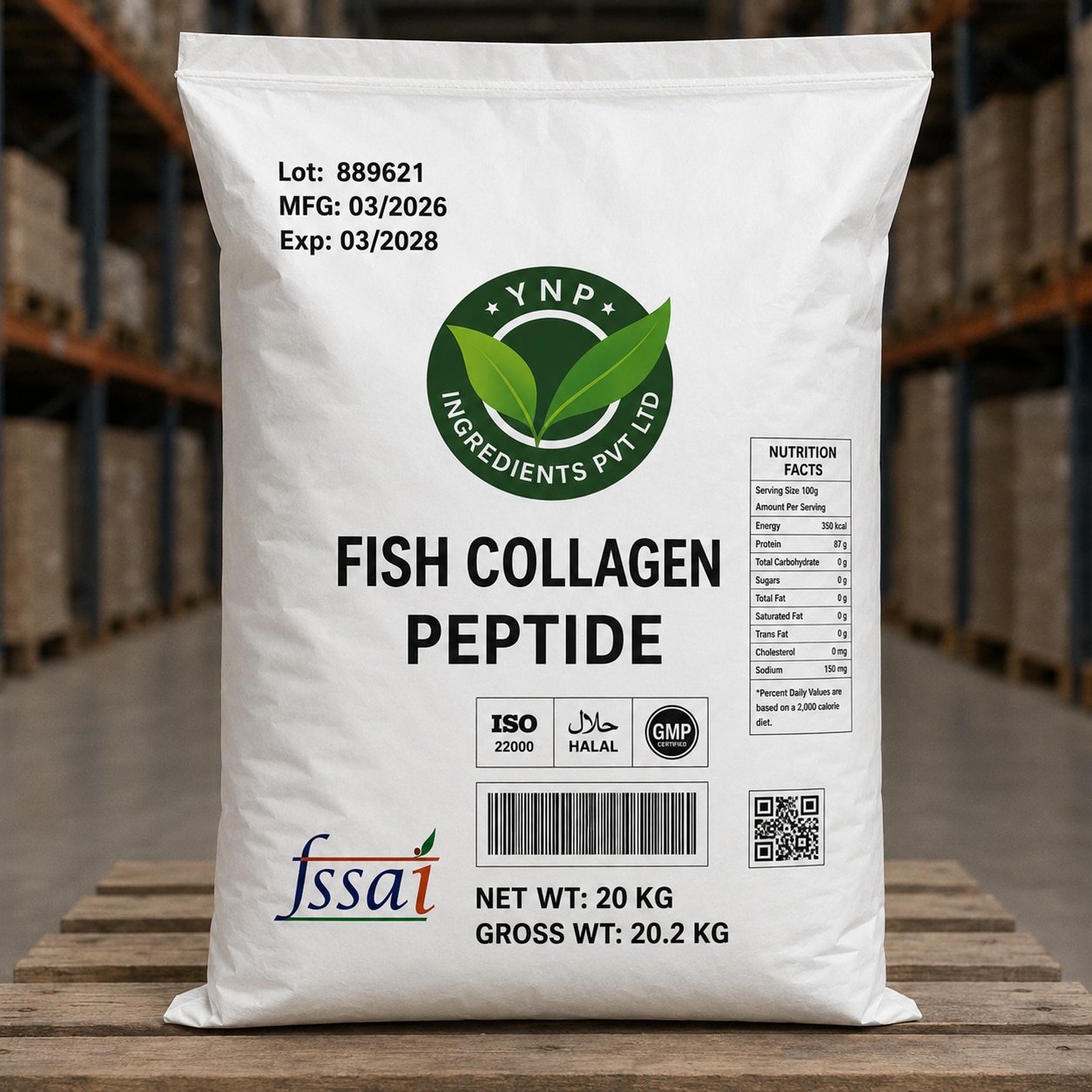 | Nutraceuticals/ Dietary Supplements Fish Collagen Peptide is a specialized nutraceutical ingredient widely utilized in dietary supplements, functional nutrition products, and healthcare... View product → |
Frequently asked questions
What information identifies a fish collagen peptide correctly?
Ask the supplier to name the fish species, tissue used, collagen type, and hydrolysis process. Skin, scale, and bone can differ in ash, odour, amino-acid profile, and contaminant controls.
Which quality evidence should supplement makers compare between fish collagen peptide lots?
Compare peptide-size data, assay results, and lot-specific evidence such as a certificate of analysis. Check that the documents identify the batch being offered.
How should you calculate a fish collagen peptide serving dose?
Match the ingredient grade to the finished format, then calculate the serving from the assay value and the target amount of active peptide. Confirm the calculation against the product’s dose and serving size.
What should Delhi buyers test before approving a fish collagen peptide supplier?
Test dissolution, stability, odour, taste, and other marine sensory characteristics in the intended formula. Qualify the supplier using identity, lot documentation, manufacturing, storage, and delivery checks.
Keywords