
Choosing magnesium L-threonate requires more than comparing purity percentages or prices per kilogram. By the end, you will be able to verify the chemical identity, calculate the real elemental-magnesium dose, test manufacturing fit, and qualify a Delhi supply lot against regulatory, quality, and landed-cost requirements.
Key takeaways
- Confirm FSSAI permission and prior-approval needs before importing a lot.
- Calculate elemental magnesium instead of comparing salt weights or headline doses.
- Match particle size, flow, and bulk density to capsules, tablets, or powders.
- Request identity, assay, contaminant, batch, and shipment documents from the supplier.
Start with Indian regulatory status and the exact chemical identity
Before approving a magnesium threonate ingredient selection, confirm that the proposed magnesium L-threonate raw material is legally usable in the intended Indian product category. Check the current FSSAI Health Supplements and Nutraceuticals Regulations, the permitted-ingredient schedule, the proposed daily serving, and whether the formulation requires prior approval before you commit to an imported lot.
1. Ask for the exact identity: magnesium L-threonate, not an unspecified magnesium threonate salt, blend, or threonate-containing premix.
2. Require the specification to state the hydration state, compound assay range, elemental-magnesium range, assay basis, carrier or excipient content, and whether the material is a single ingredient.
3. Check the certificate of analysis for separate results for magnesium L-threonate assay and elemental magnesium. A 98% compound assay does not mean 98% elemental magnesium.
4. Match the proposed elemental-magnesium contribution with every other magnesium source in the formula, including premixes and fortified ingredients. The US National Institutes of Health reference limit of 350 mg per day from supplements and medicines for adults is not an automatic Indian labelling rule, but it shows why this calculation matters.
5. Reject labels or sales copy promising memory, cognition, sleep, or neurological effects unless the claim fits the Indian category and is supported by the finished-product dossier. The ingredient name alone does not establish those benefits.
Get the supplier’s latest specification, certificate of analysis, regulatory declaration, and intended-use statement before comparing price, particle size, or landed cost.
Calculate elemental magnesium before comparing salts, doses, and costs
A 98% magnesium L-threonate assay does not mean 98% elemental magnesium. Calculate the elemental yield stated on the certificate, then size the formula: 100 mg elemental magnesium requires about 1.22 g of material at 8.2% yield, or 1.39 g at 7.2%.
| Option | Approximate elemental-magnesium density | Practical formula trade-off |
|---|---|---|
| Magnesium L-threonate | About 7.2–8.2% | High powder volume; useful only when its positioning justifies larger capsules or sachets |
| Magnesium citrate | Form-dependent, commonly higher than L-threonate | More economical volume; check acidity, taste, and solubility |
| Magnesium glycinate | Usually higher than L-threonate | Good capsule efficiency and mild taste; verify whether it is pure or buffered |
| Magnesium bisglycinate | About 14% for the chelated compound; confirm the specification | Efficient chelated format; supplier terminology and assay basis need checking |
| Magnesium malate | Form-dependent, commonly higher than L-threonate | Useful for tablets or capsules; assess taste and compression |
| Magnesium oxide | About 60% | Very compact and inexpensive, but different dissolution and tolerance characteristics |
For magnesium threonate for supplements, compare both compound assay and elemental-magnesium assay. Request the exact salt, hydration state, assay method, and carrier content; a premix is not equivalent to a single-ingredient material.
A serving calculation must include magnesium from every ingredient. The U.S. National Institutes of Health uses 350 mg per day from supplements and medicines as an adult upper limit; it excludes food magnesium and is not automatically an Indian labelling rule.
For which magnesium threonate is best for supplement formulas in Delhi, start with legal usability, then test whether the required powder fits the chosen format.
Match particle size and powder behaviour to the finished format
Capsules work only when you accept a large fill weight or multiple units: 100 mg elemental magnesium needs about 1.22–1.39 g of magnesium L-threonate at 8.2% or 7.2% elemental magnesium. Sachets and drink mixes handle that load more comfortably, while gummies usually need a lower dose or a multi-ingredient strategy.
| Format | Fit for magnesium L-threonate | Processing risks to test |
|---|---|---|
| Capsule | Suitable for large capsules or two-plus units | Poor flow, low bulk density, powder loss at the dosator, fill-weight variation |
| Tablet | Suitable when the press accepts a high active load | Capping, lamination, weak hardness, slow disintegration, sticking and segregation |
| Sachet | Strong fit for one serving | Dusting, seal contamination, moisture pickup, bridging and inconsistent discharge |
| Drink mix | Strong fit if the powder disperses and the taste is acceptable | Slow wetting, sediment, clumping, gritty mouthfeel and flavour masking |
| Gummy | Usually a difficult fit for a full magnesium dose | Excess mass, texture failure, heat exposure and uneven distribution |
| Premix | Suitable for blends, provided particle sizes and densities are close | Segregation during transfer, transport and hopper storage |
For magnesium threonate ingredient selection, request laser particle-size data, bulk density, moisture limit, flow testing and dispersibility results, not only assay. Run a pilot with the intended equipment: measure blend uniformity, capsule fill variation, tablet compression and friability, sachet seal cleanliness, and drink-mix sediment after the planned reconstitution time.
That evidence identifies the practical magnesium threonate for supplements.
Qualify the Delhi supplier, shipment, and technical document package
A magnesium L-threonate supplier in Delhi earns approval through traceability, not shelf stock. Ask for the original manufacturer’s name, country of manufacture, lot number, import documents, and chain-of-custody record. Match those details across the drum label, invoice, packing list, and certificate of analysis. A relabelled bag with only a generic assay is a stockist warning.
Request this document package for every magnesium threonate raw material lot:
- Current lot-specific COA showing compound assay and elemental-magnesium result
- Specification sheet with moisture, particle size, bulk density, microbiological limits, and heavy-metal limits
- Manufacturing-country statement, retest or expiry date, and storage conditions
- Allergen, GMO, and residual-solvent statements where relevant
- Packaging description, seal details, and transport temperature or moisture controls
- Supplier confirmation of minimum order, replenishment lead time, and lot continuity
Do not release the first shipment from paperwork alone. Use FTIR for identity, ICP-OES or ICP-MS for magnesium and heavy metals, and a validated chromatographic or titrimetric method for the threonate-related assay. Confirm that the method measures threonate or the intended compound, not merely total magnesium. Compare the supplier’s COA with an independent laboratory report.
YNP Ingredients Pvt Ltd should be assessed by the same evidence: confirm whether its offered lot links to the original manufacturer and whether its documents support the exact Indian product category. Check the current FSSAI Health Supplements and Nutraceuticals schedules, serving size, and prior-approval position before placing an import order.
Related product
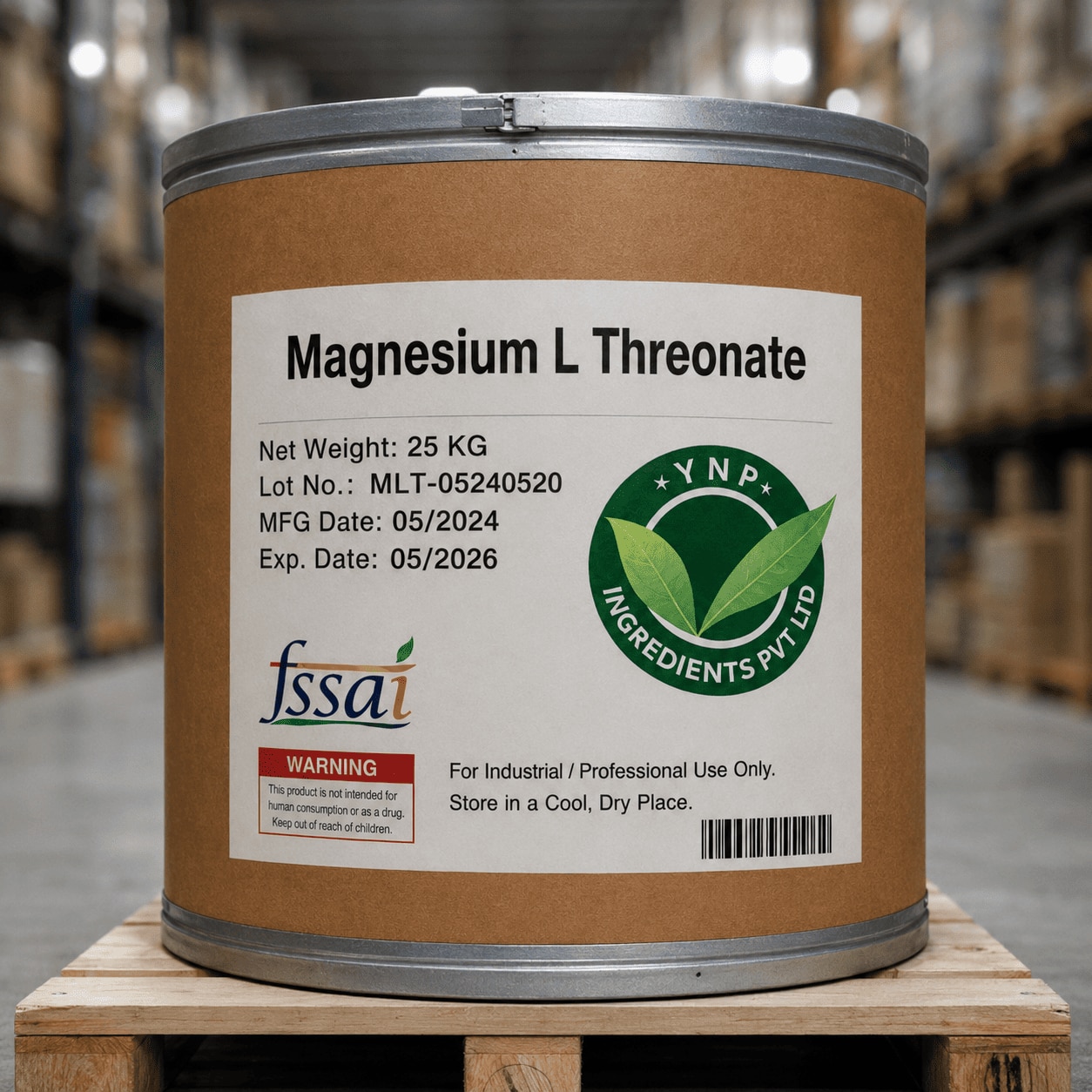 | Vitamins Magnesium L Threonate is a premium-grade mineral ingredient widely used in nutraceutical, healthcare, and wellness formulations for its advanced... View product → |
Decide when L-threonate earns its volume and cost premium
The premium earns its place only when the product brief supports a large serving, higher raw-material cost, and a clear reason to specify L-threonate. At about 8.2% theoretical elemental magnesium, 200 mg of elemental magnesium requires roughly 2.44 g of anhydrous material; a hydrated or lower-assay commercial grade requires more.
The answer to which magnesium threonate is best for supplement formulas in Delhi depends on usable elemental yield, not the headline “98%” compound assay. Choose it when a premium cognitive-positioned formula accepts capsule or sachet volume and the finished product can carry the landed cost.
Request the verified elemental-magnesium assay, moisture basis, and cost per gram of elemental magnesium.
Magnesium threonate ingredient selection becomes poor when the formula must deliver substantial magnesium in a small tablet, combine several minerals, or keep the serving cost low. A denser salt gives the formulator more room.
| Option | Choose it when | Main compromise |
|---|---|---|
| Magnesium L-threonate | Premium formula accepts roughly gram-level serving weight | Low elemental density and higher cost |
| Magnesium glycinate or bisglycinate | You need a compact, premium-positioned capsule | Compare assay, chelation specification, and cost |
| Magnesium citrate or malate | You need a practical balance of density, cost, and formulation flexibility | Taste, moisture, and gastrointestinal tolerance require testing |
| Magnesium oxide | The brief prioritises maximum density and low raw-material cost | Lower solubility and a less suitable premium positioning |
Check total daily elemental magnesium across every serving. A larger load can increase diarrhoea, nausea, or abdominal cramping, so do not let a premium ingredient obscure dose and excipient decisions.
Frequently asked questions
What should you verify before using magnesium L-threonate in an Indian supplement?
Check the current FSSAI Health Supplements and Nutraceuticals Regulations, the permitted-ingredient schedule, the proposed daily serving, and any prior-approval requirement for the intended product category.
How do you compare magnesium threonate with other magnesium salts?
Calculate elemental magnesium from the assay and chemical form first, then compare the required salt weight, serving size, capsule or tablet space, and ingredient cost.
Which powder properties matter for magnesium threonate supplement formulas?
Request particle-size data, bulk and tapped density, moisture, flow behaviour, and dispersibility, then match them to the selected capsule, tablet, sachet, or drink format.
What documents should a Delhi buyer request from a magnesium threonate supplier?
Ask for the specification and certificate of analysis, batch and manufacturing details, identity and assay results, heavy-metal and microbiological testing, allergen and residual-solvent statements, stability information, and import-shipment documents.
When does magnesium L-threonate justify its higher cost and formulation volume?
It earns the premium when its intended positioning, target serving, evidence strategy, and finished-format economics justify the lower elemental-magnesium density and larger raw-material requirement.
Keywords