Choosing biotin for a sports-nutrition formula is less about selecting the highest assay and more about controlling identity, microgram-level dosing, dispersion, documentation, and label claims. By the end, you will be able to distinguish D-biotin from carrier-based premixes and finished products, match each option to a dosage format, and build a supplier checklist for Delhi procurement.
Key takeaways
- Request D-biotin with CAS 58-85-5 and formula C10H16N2O3S.
- Match the raw material’s form and carrier to your dosage format.
- Control microgram dosing with validated blending and assay checks.
- Compare pure biotin and premixes using a written purchase specification.
Which biotin raw material are you actually buying?
The buying decision starts with chemical identity, not the word “biotin” on a quotation. For a biotin ingredient for sports nutrition, request D-biotin, also called dextrorotatory biotin or vitamin B7, with CAS 58-85-5 and molecular formula C10H16N2O3S. Do not treat L-biotin or an unspecified stereoisomer as equivalent.
| Option | Chemical identity | Commercial use |
|---|---|---|
| D-biotin | Neat D-biotin active, usually supplied as a low-dose powder | Used when the manufacturer controls microgram weighing, geometric dilution, and blend uniformity |
| Biotin premix | D-biotin diluted onto a carrier such as maltodextrin; the specification must state the dilution ratio and assay basis | Used to improve dosing accuracy and handling in powders, sachets, tablets, capsules, gummies, or beverage blends |
| Finished dosage form | D-biotin already formulated into a tablet, capsule, gummy, sachet, or drink, with excipients and a declared serving amount | Sold as a consumer product, not purchased as a flexible raw material for further formulation |
Pure D-biotin from two suppliers can share the same chemical identity yet behave differently in production because particle size, flow, carrier load, documentation, minimum order quantity, and lead time differ. Those details make up the practical biotin raw material options.
For a Delhi purchase, keep the categories separate: an overseas certificate of analysis confirms a batch’s stated properties, but it does not by itself establish FSSAI authorization, permitted nutrient levels, import clearance, or finished-label compliance.
Which biotin form fits tablets, capsules, gummies, powders, and drinks?
Pure D-biotin fits tablets and capsules when the manufacturer can control microgram weighing through geometric dilution and validated blending. A premix is safer when the production line needs a larger, free-flowing addition that reduces weighing error and improves distribution.
| Option | Best-fit formats | Manufacturing decision |
|---|---|---|
| Pure D-biotin | Tablets, capsules, small powder batches | Use only with a controlled premix step; direct addition can produce hot spots and under-dosed units. |
| Biotin premix | Tablets, capsules, sachets, sports powders | Choose the carrier and concentration to match flow, moisture, blend time, and active-equivalent calculations. |
| Biotin premix or validated liquid system | Drinks | Do not assume neat D-biotin will dissolve; its low water solubility can cause settling, poor dispersion, and uneven servings. |
| Premix for gummy base | Gummies | Confirm compatibility with the syrup, heat exposure, water activity, and flavour system before scale-up. |
For Biotin forms compared for sports nutrition in Delhi, gummies need more than a potency certificate: the premix must remain uniform through heating, depositing, and cooling. A pure powder can work in a dry powder or sachet only after the blender proves content uniformity across samples.
For drinks, qualify a compatible premix, solution system, or high-shear process. Calculate every addition as D-biotin active equivalent, because a 1% premix and a 10% premix require different input weights and create different carrier loads.
How do you control microgram dosing without overstating performance benefits?
Set the inclusion level from the intended nutritional contribution, not from a presumed training effect. The U.S. National Academies’ adult adequate-intake value is 30 micrograms per day; it is a nutrition reference, not a sports-performance target. If you formulate above that amount, document why and calculate the declared quantity from the D-biotin assay.
| Option | Inclusion-control method | Main failure to prevent |
|---|---|---|
| Pure D-biotin | Make a geometric dilution with a compatible excipient before adding it to the main batch | A small weighing error becomes a large potency variation |
| Standardised premix | Calculate the required carrier quantity from active-equivalent potency, not total powder weight | Incorrect dilution-ratio or assay-basis calculations |
| Liquid format | Qualify a dispersible premix or validate high-shear processing and sampling | Pure powder remains incompletely dispersed because biotin is sparingly soluble |
For large batches, take samples from defined locations and verify content uniformity against your finished-product specification. A premix reduces microgram weighing risk, but qualify its carrier for segregation during transport, moisture pickup, microbial limits, and compatibility with the formula. Record the premix ratio and D-biotin assay on the batch worksheet.
Keep the claim narrower than the formula’s marketing ambition:
- Use a permitted nutrition claim only when the finished serving meets the applicable threshold and the label wording is substantiated.
- Do not present biotin as increasing strength, endurance, fat loss, recovery, or exercise capacity without specific evidence and a lawful basis for that claim.
- Do not use deficiency-related hair, skin, neurological, or metabolic effects as proof of benefit for biotin-replete athletes.
What should a Delhi buyer verify before approving a biotin supplier?
Do not approve a quotation on “biotin” or “USP grade” alone. Ask the biotin supplier in Delhi to identify the material as D-biotin (dextrorotatory biotin), CAS 58-85-5, molecular formula C10H16N2O3S; L-biotin and unspecified stereoisomers are not interchangeable.
| Checkpoint | Documents or evidence to request | What failure means |
|---|---|---|
| Identity | Product specification, identity test method, and certificate of analysis (CoA) showing D-biotin | An HPLC assay alone does not prove chemical identity |
| Potency | Batch assay result, method, assay basis, units, and stated premix concentration | You cannot calculate the finished-product dose reliably |
| Composition | Carrier declaration, carrier percentage, particle-size data, and allergen statement for premixes | A “biotin powder” may be diluted or unsuitable for uniform blending |
| Safety | Microbiological limits, heavy-metal limits, residual-solvent statement, and contaminant or allergen declaration | The batch may fail your internal release specification |
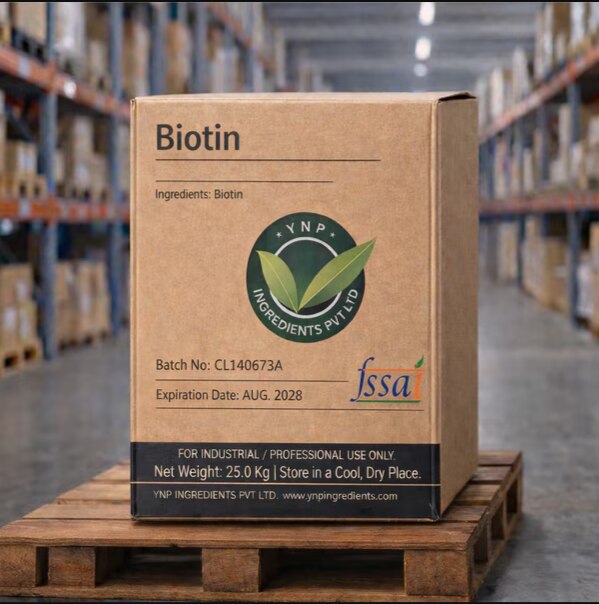
| Traceability | Batch or lot number, manufacturer, country of origin, manufacturing date, and retest or expiry date | A complaint or recall cannot be linked to source |
| Storage | Label or specification stating temperature, humidity, light protection, pack size, and inner-liner material | Heat, moisture, or sampling exposure can damage low-dose control |
Before ordering, request the applicable USP or FCC monograph or the supplier’s full specification; “food grade” and “pharmaceutical grade” are not molecules or proof of testing. Also obtain the finished-product category, FSSAI authorization or licence details, permitted nutrient level, label declaration requirements, import documents, and clearance requirements for India.
An overseas CoA does not establish Indian compliance.
A vitamin B7 supplier for supplement manufacturers, including YNP Ingredients Pvt Ltd, should explain how each lot is sampled and released, not merely forward a generic certificate. Reject material with broken seals, mismatched lot numbers, missing retest dates, or storage conditions that your Delhi warehouse cannot maintain.
How should you compare pure biotin with a premix in the purchase specification?
Choose the material that delivers the required D-biotin dose with the lowest total control burden, not the lowest price per kilogram. Write potency as active D-biotin equivalent and state the assay basis, dilution ratio, carrier, pack size, and acceptance limits.
| Factor | Pure D-biotin | Biotin premix |
|---|---|---|
| Active potency | High assay; calculate microgram addition directly | Lower assay; calculate from the declared active-equivalent concentration |
| Carrier load | None or negligible; less material enters the formula | Adds maltodextrin or another named carrier, increasing formula mass |
| Manufacturing effort | Needs accurate micro weighing, geometric dilution, and blend-uniformity checks | Easier weighing and distribution at microgram doses; qualify segregation and compatibility |
| Minimum order quantity | Often better for low-volume or multiple products if the supplier offers small packs | A larger MOQ can leave excess carrier-heavy stock |
| Storage | Follow the supplier’s temperature, humidity, light, and liner requirements | Control moisture more closely; carrier pickup can change flow and blend behaviour |
| Landed cost | Higher active price can still mean lower freight and handling cost | Compare price per delivered gram of active, including carrier, freight, duty, testing, and waste |
| Batch approval | Confirm D-biotin identity, assay, lot, dates, and microbiological and heavy-metal results | Confirm all of those plus carrier identity, dilution uniformity, moisture, and segregation risk |
Approve a premix when its reduced weighing and blending effort outweighs added freight, storage, and testing. Approve pure material when your process can control microgram dosing and the premix’s carrier would disrupt the formula.
Frequently asked questions
Which biotin raw material should sports nutrition manufacturers buy?
Request D-biotin, also called dextrorotatory biotin or vitamin B7, with CAS 58-85-5 and molecular formula C10H16N2O3S. Do not approve L-biotin or an unspecified stereoisomer as equivalent.
Which biotin form fits tablets, capsules, gummies, powders, and drinks?
Choose the form according to dispersion, dose uniformity, processing, and finished-product format. Check whether the supplier offers pure powder or a carrier-based premix suitable for your blending and filling process.
How can manufacturers control microgram biotin dosing?
Use a validated dilution and blending process, define the assay target and acceptable tolerance in the specification, and verify blend uniformity and finished-product content. Avoid presenting biotin as a performance enhancer unless your approved evidence and claims support it.
What should a Delhi buyer verify before approving a biotin supplier?
Verify the identity, CAS number, assay, batch number, certificate of analysis, manufacturing and expiry dates, storage conditions, packaging seal, traceability documents, and the supplier’s applicable food or supplement licences.
How should pure biotin be compared with a premix?
Compare biotin concentration, carrier ingredients, assay tolerance, particle behaviour, moisture, microbial limits, shelf life, storage requirements, minimum order quantity, and the effect on your formula’s label and dosing calculations.
Keywords