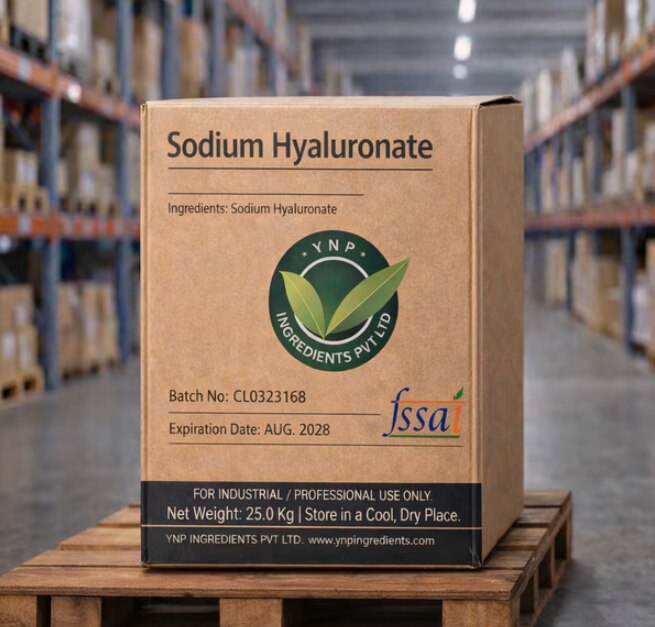
Choosing sodium hyaluronate for a supplement involves more than comparing a name and a quoted rate. You will be able to compare molecular-weight grades, calculate a defensible formulation requirement, test the ingredient in its intended format, and verify whether a Delhi quotation represents stock you can actually receive.
Key takeaways
- Match molecular weight and physical form to your dosage format.
- Request the COA, specification sheet, allergen statement, and licence documents.
- Test dispersion, dissolution, moisture handling, and stability before production.
- Compare freight, GST, pack size, testing, and wastage—not just the quoted price.
Which sodium hyaluronate grade fits your supplement formula?
Sodium hyaluronate is the sodium salt of hyaluronic acid, but those names are not interchangeable for specification, labelling, or procurement. Before requesting samples, identify the physical form and molecular-weight range.
| Material | What it means | Formulation relevance |
|---|---|---|
| Non-cross-linked sodium hyaluronate | A soluble powder used for oral nutraceutical applications | Evaluate for tablets, capsules, sachets, gummies, or beverages |
| Cross-linked hyaluronic-acid gel | A structured gel designed for injectable, cosmetic, or topical use | Do not treat it as suitable for oral products without specific documentation |
| Molecular-weight grade | A defined polymer-size range, not merely “sodium hyaluronate” | Determines dissolution speed, viscosity, mouthfeel, clarity, particle handling, and formulation positioning |
Higher molecular weight often produces thicker solutions and a heavier mouthfeel; lower molecular weight can disperse faster and support clearer, easier-to-handle systems. The actual result depends on processing.
Ask a sodium hyaluronate supplier in delhi to state the fermentation organism, purification process, particle size, purity, molecular-weight range, and intended use. These details affect performance and price. A quote without a molecular-weight range is not comparable with one that provides it. Cross-check every grade against your formula and label declaration before approval.
How should you use it in tablets, capsules, sachets, gummies, and drinks?
Do not copy a cosmetic or injectable-use level into an oral supplement. Set inclusion from the finished product’s intended serving size and the supplier’s technical data sheet, which must state the intended dosage, recommended serving concentration, and method of calculation.
Confirm whether assay is reported on an as-is or dry basis; these figures are not interchangeable.
1. For tablets and capsules, pre-blend the powder with a compatible portion of the diluent before adding the remaining excipients. Check blend uniformity, flow, compression, and capsule fill weight during a pilot.
2. For sachets, disperse sodium hyaluronate in a controlled sequence with free-flowing carriers. Poor wetting can leave floating clumps when the consumer mixes the powder.
3. For ready-to-mix drinks, define water quality, addition order, shear, and hydration time. A powder that works in a capsule blend can create lumps, haze, or excessive viscosity in a clear beverage.
4. For gummies, test hydration, heating exposure, pH, salts, minerals, proteins, texture, and storage stability before approval. These variables can change viscosity and appearance.
Use the same checks when you buy sodium hyaluronate in delhi: request technical data for the exact lot and formulation route, not a generic catalogue recommendation.
What specifications and documents should you request before approval?
Before approval, make the file prove both what the powder is and how the supplier tested it—not merely that it is “99% pure.”
1. Request a specification sheet stating sodium-hyaluronate content or assay, molecular-weight range, loss on drying or moisture, pH of a defined solution, particle size, bulk density, and viscosity or intrinsic-viscosity method. Include protein or residual-organic impurity limits.
2. Require limits for total microbial count, yeast and mould, specified pathogens, heavy metals, and residual solvents. Add endotoxin limits when the application or customer specification requires them; a low microbial count does not prove endotoxin absence.
3. Ask for country of origin, fermentation organism and controls, purification process, residual host-cell or process-impurity information, allergen and GMO statements, and intended-use or food-status documentation.
4. Collect a lot-specific certificate of analysis, safety data sheet, allergen declaration, stability or storage information, and food or nutraceutical regulatory documents. Check that the COA names the supplied lot, manufacturing date, expiry or retest date, test methods, numerical results, specification limits, authorised signatory, and laboratory source.
“Purity 99%” alone cannot show molecular weight, moisture, viscosity, contaminants, or microbiological safety. Reject a file that offers a generic COA instead of results tied to the commercial lot.
How do you test dissolution, handling, and stability before production?
A technically acceptable powder can still fail in production. Sodium hyaluronate is hygroscopic, so humidity can cause caking, alter weighing, and slow dispersion.
1. Inspect the pack before testing. Confirm the original container, liner type, net weight, intact seal, manufacturer-stated temperature limit, humidity guidance, and whether an opened pack can be resealed. Record these controls for storage and stability review.
2. Request a sample from the same commercial lot or production route intended for bulk supply. A different laboratory lot cannot prove matching moisture, particle size, viscosity, or dissolution performance.
3. Run a small pilot in the final delivery format using your intended water quality, mixing order, shear, pH, salt level, proteins, minerals, and hydration time. Changing any of these variables can turn a clear dispersion into lumps, haze, or excessive viscosity.
4. Record clump formation, wetting, dissolution time, viscosity, appearance, sedimentation, and blend uniformity. Test the result after the planned hold period, then compare it with the specification and the manufacturer’s storage instructions before releasing the material for production.
How should you compare a Delhi quote with the real delivered cost?
A sodium hyaluronate price in Delhi is not comparable until you match molecular-weight grade, purity, pack size, quantity, origin, stock status, taxes, freight, testing charges, and payment terms. Compare the complete specification before comparing per-kilogram rates.
| Quote type | What it usually means | Costs to confirm |
|---|---|---|
| Ex-warehouse Delhi | Material is available for collection from a named Delhi warehouse | Taxes, domestic freight, sampling, independent testing, and payment terms |
| Landed Delhi | Import costs are included up to the agreed delivery point | Customs duty, IGST, port or airport charges, clearance, domestic freight, sampling, and independent testing |
Ask whether the stock is physically held in Delhi or imported only after order. Request the warehouse location, lot number, quantity in stock, remaining shelf life, and the point where lead time begins: purchase order, dispatch, or import clearance.
Small packs and indent quantities usually cost more per kilogram than recurring orders or pallet quantities. To buy sodium hyaluronate in Delhi, request a sample from the same commercial lot or production route intended for bulk supply.
A Delhi sourcing discussion with YNP Ingredients Pvt Ltd becomes more useful when you ask these questions directly and require lot-linked documentation instead of accepting a catalogue rate.
Related product
 | Amino Acid Sodium hyaluronate is a salt form of hyaluronic acid widely used in nutraceutical and food ingredient formulations for its powerful hydration and... View product → |
What should you verify before approving an India-wide supply partner?
A sodium hyaluronate ingredient supplier India brands can rely on must prove control beyond the first delivery. Trace the material one step back to the manufacturer, and request food-safety or quality-system documents, allergen and GMO statements where relevant, contaminant limits, and the laboratory basis for each result.
1. Ask for written complaint, recall, and out-of-specification procedures. Confirm who investigates, who approves disposition, and how quickly you receive a root-cause report.
2. Require documented change control. Ask how the supplier will notify you before changes to the fermentation site, molecular-weight distribution, excipient carrier, packaging, test method, or manufacturing site. Any of these can alter dissolution, dosage calculations, or finished-product performance.
3. Do not treat “food grade” as proof of FSSAI compliance. Review the finished product’s permitted ingredient, category, dosage, claims, label wording, and manufacturing controls against current Indian requirements.
4. Before commercial production, confirm the material form and assay basis, clear the pilot batch, approve the lot-specific COA, record storage controls, and define requalification triggers. Include a new manufacturer, changed test method, altered molecular-weight range, failed trend, packaging change, or extended storage excursion as triggers.
Frequently asked questions
Which sodium hyaluronate grade fits a supplement formula?
Choose the molecular-weight range, viscosity, purity, particle size, and physical form that suit your tablet, capsule, sachet, gummy, or beverage process.
What documents should you request from a sodium hyaluronate supplier?
Request the batch-specific certificate of analysis, product specification, allergen and declaration statements, safety data sheet, origin details, and applicable manufacturing or licence documents.
How should you test sodium hyaluronate before production?
Check dispersion, dissolution, handling, moisture sensitivity, compatibility with other ingredients, and stability in the finished dosage form using a representative sample.
How do you compare sodium hyaluronate price in Delhi?
Calculate the delivered cost after freight, GST, pack size, sampling, testing, storage, minimum order quantity, and any process losses.
What should you verify before choosing an India-wide supplier?
Verify traceability, batch consistency, documentation, inventory and lead times, replacement terms, shipping capability, and support for repeat procurement.
Keywords