CLA is not one uniform raw material: its isomer ratio, assay basis, physical format, oxidation state and documentation can change both formulation performance and landed cost. By the end, you will know how to specify CLA, compare Delhi quotations on an active-content basis and qualify a lot before committing to wholesale purchase.
Key takeaways
- Compare cis-9, trans-11 and trans-10, cis-12 percentages before comparing CLA prices.
- Choose oil, softgel-grade material or powder according to your finished product process.
- Match the certificate of analysis, batch number and shipment documents to each lot.
- Qualify storage conditions, sampling and release tests before accepting the first commercial batch.
What CLA is, and why the isomer specification matters
Conjugated linoleic acid is a group of positional and geometric isomers of the polyunsaturated fatty acid linoleic acid, not an amino acid. Commercial CLA ingredients are therefore mixtures, and you cannot treat every CLA oil or powder as interchangeable.
The two principal isomers to request by name are cis-9,trans-11 and trans-10,cis-12. Their ratio changes with the manufacturing process and product grade, so two materials labelled CLA can have different composition and formulation relevance.
- Ask for the assay basis: “80% CLA” might mean total CLA by GC, the combined concentration of the two named isomers, or total fatty-acid content. These figures are not equivalent.
- Request a fatty-acid profile by GC-FID or GC-MS, with separate limits for cis-9,trans-11 and trans-10,cis-12.
- Record the isomer ratio in your specification and compare it across samples, commercial lots and supplier quotations.
A high assay does not prove a large weight-management effect; clinical evidence describes modest and inconsistent outcomes. Review finished-product claims against clinical evidence and current regulatory requirements before using them on labels or marketing material.
If you search for “conjugated linoleic acid supplier india,” use the same technical basis for every quotation. A supplier that reports only total CLA leaves you unable to compare isomer distribution, dose calculations or evidence behind the intended claim.
Choose the CLA format for the product you are making
Choose oil for softgel filling or other oil-based systems; choose dry powder for tablets, sachets, protein powders and dry premixes. Finished softgels or capsules suit products where encapsulation is already complete, while bulk oil or powder gives you control over the final formula.
| Format | Best fit | Main trade-off |
|---|---|---|
| Neat or concentrated CLA oil | Softgel filling, oils, liquid blends | Requires oxidation control and filling operations |
| Dry microencapsulated or carrier-based powder | Tablets, sachets, protein powders, dry premixes | Easier handling, but carriers reduce active CLA concentration |
| Finished softgels or capsules | Ready-to-sell dosage units | Less control over dose, excipients and packaging |
Read powder assay on an as-is basis. A powder labelled 80% CLA does not deliver 80% active CLA by weight if carriers and coating materials make up the balance. Ask for the carrier identity, active CLA percentage, flow properties, dispersibility, hygroscopicity and particle-size distribution.
For CLA for nutrition products, calculate the serving from declared active CLA, not gross powder weight. Validate blend uniformity in the premix and check compatibility with proteins, flavours, minerals, oils and other actives.
Bulk material gives you control over dose, excipients and packaging, but adds encapsulation, stability, release testing and label work. Finished material reduces those tasks but limits reformulation. Route serving size, safety and claims through regulatory and clinical review rather than adopting a universal dose.
Build a CLA specification and match every document to the lot
Approve a CLA lot only against a written specification that defines what “80% CLA” means and how the result is accepted.
| Parameter | Requirement to state | Named evidence or method |
|---|---|---|
| Total CLA and isomers | Total assay basis; cis-9,trans-11 and trans-10,cis-12 limits and ratio | GC-FID or GC-MS fatty-acid profile |
| Form and composition | Free-fatty-acid or triglyceride form; carrier, excipient and antioxidant identity | Product specification sheet and formulation declaration |
| Quality and safety | Moisture, peroxide value, acid value, anisidine value or equivalent secondary-oxidation data; residual solvents where relevant | Named test methods on the COA |
| Contaminants and use | Heavy metals, microbiological limits, allergens and shelf life | COA and specification sheet |
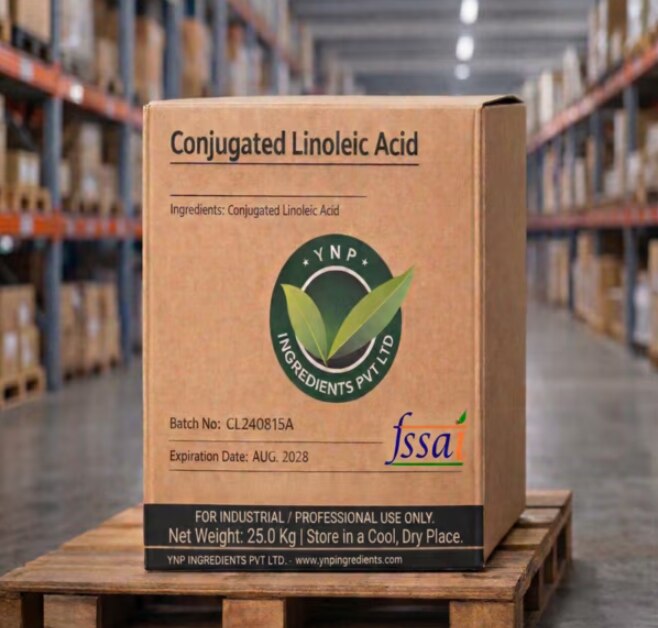
The document pack must include a batch-specific certificate of analysis, product specification sheet, safety data sheet, certificate of origin, manufacturing date, expiry or retest date, batch number and packaging configuration. Match the COA batch number to the number printed on the delivered drum, bag or carton before release.
Put these terms in the purchase order:
- Minimum remaining shelf life at delivery
- Assay tolerance and individual isomer limits
- Peroxide, acid and secondary-oxidation limits
- Sampling plan, sample quantity and acceptance method
- Remedy for an out-of-specification lot: replacement, credit or return
One COA proves the tested batch only. It does not guarantee future lots unless the supplier accepts the same specification, test methods and acceptance terms for every shipment. A sample that passes without these controls can still conceal a changed isomer ratio, carrier level or oxidation state in the commercial batch.
How to compare CLA bulk price in Delhi on a like-for-like basis
A CLA ingredient bulk price in Delhi is comparable only after you convert each offer to landed rupees per kilogram of declared active CLA. Invoice rupees per kilogram of material can mislead: carrier solids dilute powder, while a lower-assay oil delivers less active CLA.
| Commercial basis | What the quote includes | Risk of miscomparison |
|---|---|---|
| Ex-warehouse Delhi | Stock price before your onward freight and taxes | You bear delivery and possibly documentation costs |
| Import-cleared | Imported lot cleared through customs, with clearance costs identified | Duties, GST and local freight may still be separate |
| Delivered-duty-paid | Delivery to the named location with duties included | Confirm whether GST, unloading and insurance are included |
Ask every conjugated linoleic acid supplier in delhi to state:
- Form, total CLA assay basis, cis-9,trans-11 and trans-10,cis-12 ratio, origin, pack size and minimum order quantity
- Remaining shelf life, freight, customs treatment and commercial basis
- Quantity, format, target isomer profile, packaging and delivery location
- GST invoice requirement, certificate of origin, batch COA and import documentation
A Delhi stock point does not prove Indian manufacture or regulatory readiness. For a conjugated linoleic acid supplier india search, request batch traceability, country of origin, import records and food-business licence details where applicable.
YNP Ingredients Pvt Ltd can serve as a Delhi-based B2B sourcing and distribution contact, but evaluate any offer on the same evidence.
Use “buy CLA wholesale” only after confirming the active-CLA calculation. The lowest invoice price can produce the highest usable cost.
Related product
 | Amino Acid Conjugated Linoleic Acid (CLA) Conjugated Linoleic Acid (CLA) is a naturally occurring fatty acid widely used in nutraceutical and food ingredient formulations for weight... View product → |
Qualify, store and release the first commercial CLA lot
Release the first commercial lot only after a qualification sample passes independent testing and a pilot run. This sequence prevents an oil-grade CLA from being approved on a powder assay basis, or a carrier-heavy powder from being judged like neat oil.
1. Test the qualification sample against total CLA, c9,t11 and t10,c12 isomers, carrier content, peroxide value, acid value, anisidine value or equivalent secondary-oxidation result, moisture and microbiology. For CLA for nutrition products, confirm whether the assay is oil, powder or as-is basis.
2. Process the sample at pilot scale. For oil, review peroxide, acid and secondary-oxidation results before filling. For powder, measure moisture, flow, dispersibility and blend uniformity with the intended premix.
3. Before you buy CLA wholesale, approve a commercial specification and test the delivered lot independently. Match its batch number to the drum, bag or carton, then release it only when isomer distribution, carrier content and oxidation results meet the agreed limits.
4. Protect CLA from heat, light, oxygen and moisture. Verify the supplier’s storage temperature, nitrogen flushing or low-oxygen headspace, sealed packaging, light-resistant container and antioxidant declaration. Confirm Delhi transport and warehouse conditions; printed shelf life alone cannot show that the lot remained stable.
Finish the review under current FSSAI requirements for the finished nutraceutical, health supplement or food product: permitted ingredient status, category, composition, labelling and claims. An overseas COA or food-grade statement does not replace finished-product compliance.
Frequently asked questions
Why does the CLA isomer specification matter?
Commercial CLA is a mixture of linoleic acid isomers. Compare the stated percentages of cis-9, trans-11 and trans-10, cis-12 before treating two materials as equivalent.
Which CLA format should you choose for a nutrition product?
Choose the format that fits your process: oil for liquid or softgel applications, and a suitable powder for products that require dry blending. Check flow, carrier composition, assay and processing compatibility.
What documents should you request from a CLA supplier?
Request a product specification, lot-specific certificate of analysis, safety or contaminant results where applicable, packing details, batch number and transport or storage requirements. Confirm that every document identifies the shipped lot.
How can you compare CLA bulk price in Delhi fairly?
Compare the same CLA format, isomer assay, pack size, minimum order quantity, Incoterm, GST treatment, freight, shelf life and lot documentation. A lower quoted price is not equivalent when assay or delivered cost differs.
Keywords